5:00 p.m. — Renato Nicolaï in his garden
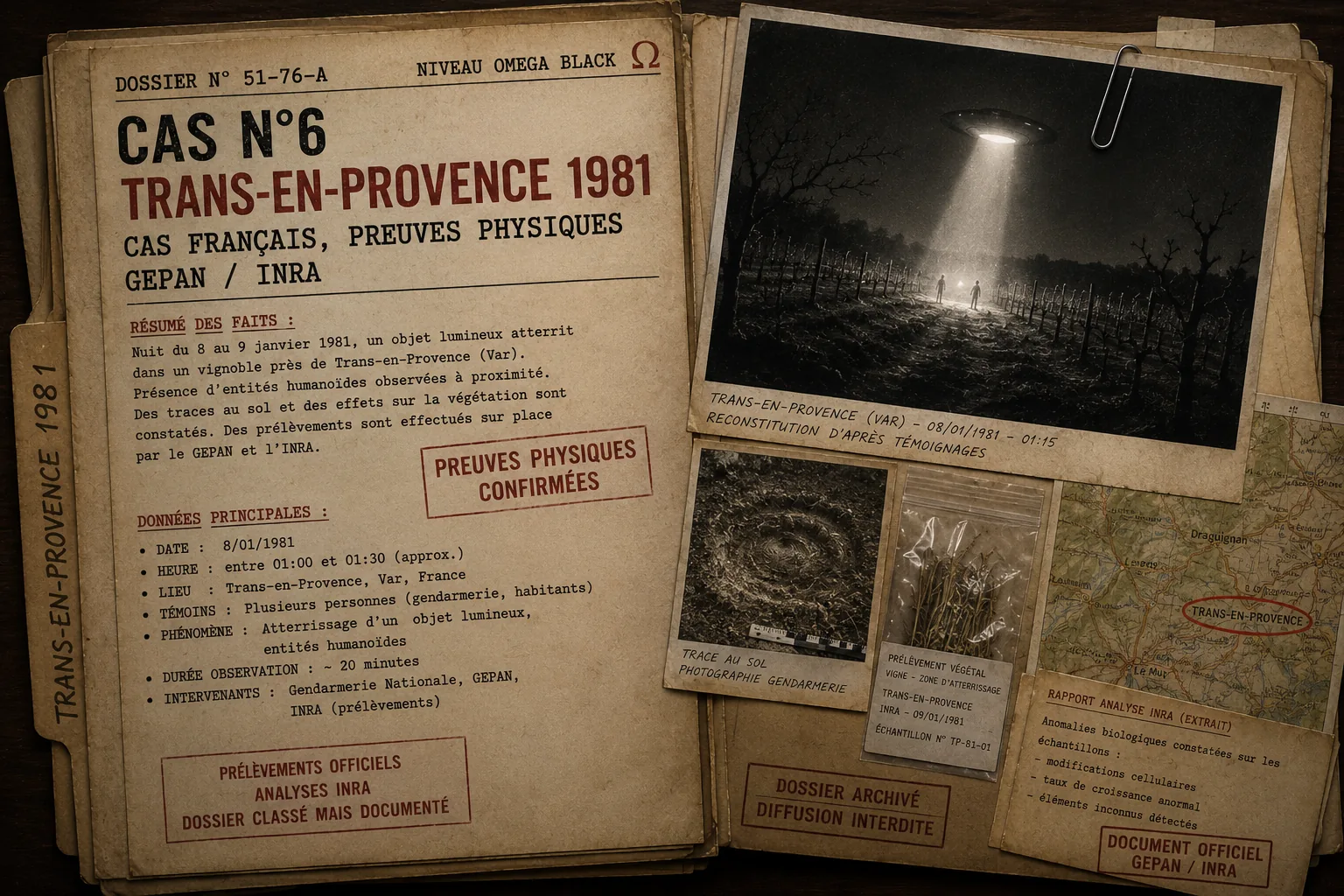
On January 8, 1981, around 5 p.m., Renato Nicolaï, 55, was tinkering in his tool shed when he heard a dull whistle. He goes out and sees, about 50 meters away, a circular object, about 1.5 meters in diameter and 1 meter high, lead gray, landing on a terrace below his garden.
The object is described as resembling "two bowls turned upside down", with two protruding bands around the edge and four holes at the base. It sits on the ground for a few seconds, then takes off with a whistling sound, raises a cloud of dust, and disappears towards the northeast.
Nicolaï immediately goes to the terrace and notices two concentric circles traced in the ground, and a crown of light burn on the vegetation. He reported the sighting to the police the next morning.
GEPAN’s intervention — analysis of traces on the ground
The Draguignan gendarmerie took soil and plant samples from the site on January 9. She transmits them to GEPAN (Unidentified Aerospace Phenomena Study Group), then based at CNES in Toulouse.
GEPAN mandates several laboratories to analyze the samples:
- INRA Phytopathology Laboratory (Avignon) : analysis of plants (alfalfa) taken in and around the trace.
- Geology laboratory of the University of Metz : soil analysis.
- Institute of Surface Chemistry and Interfaces (ICSI, Mulhouse) : thermal analysis of the soil.
INRA results: modified chlorophyll
The results of INRA's analyzes are the most remarkable part of the Trans-en-Provence file. The researchers analyzed alfalfa leaves taken at different distances from the track.
Results published in the GEPAN technical note n°16 (1983) :
- The plants collected in the trail present a 30 to 50% reduction in their chlorophyll and carotenoid content compared to controls collected off-site.
- The reduction is inversely proportional to the distance from the center of the trace: the closer you are, the more the plants are affected.
- This gradient distribution is characteristic of a central source of irradiation — and not from a uniform mechanical shock or a herbicide.
- The biochemical modifications correspond to a intense oxidative stress and a disruption of the Calvin cycle.
“The phenomenon observed [on plants] does not correspond to any known cause of chlorophyll degradation under natural or usual experimental conditions. »
— GEPAN technical note n°16, CNES, 1983
GEIPAN classification and scientific significance
The Trans-en-Provence case is closed Class D by GEIPAN (Phenomenon not explained despite complete investigation). In 2026, it remains the only UFO case in the world with:
✓ What is established by laboratory analyzes
- A mechanical trace on the ground incompatible with any known machine from 1981.
- Heating of the ground (300–600°C) over an extremely short period of time.
- Biochemical changes in chlorophyll distributed in a gradient around a central source, published in an official institutional report.
- A unique witness with no psychiatric history or particular interest in lying — Nicolaï has never put himself forward in the media.
⚠ Limitations of the survey
- Only one direct witness to the observation (Nicolaï).
- No contemporary video or photo recording.
- The origin of the biochemical modifications remains unestablished — they are real and measured, but their precise physical cause (electromagnetic radiation, heat, force field?) is unknown.
Sources and further reading
- GEPAN — Technical note n°16: “Investigation 81/01 — Analysis of a trace”, CNES Toulouse, 1983
- INRA Avignon — phytopathological analysis report of samples from January 9, 1981
- Michel Bounias (INRA) — article in Journal of Scientific Exploration, 1990
- GEIPAN — online file for the Trans-en-Provence case (Class D) — https://www.cnes-geipan.fr/
- Jean-Jacques Vélasco — UFO, the evidence, Robert Laffont, 2007
- Yves Sillard — Unidentified aerospace phenomena, Le Cherche Midi, 2007