6:58 p.m.: a V of light above France
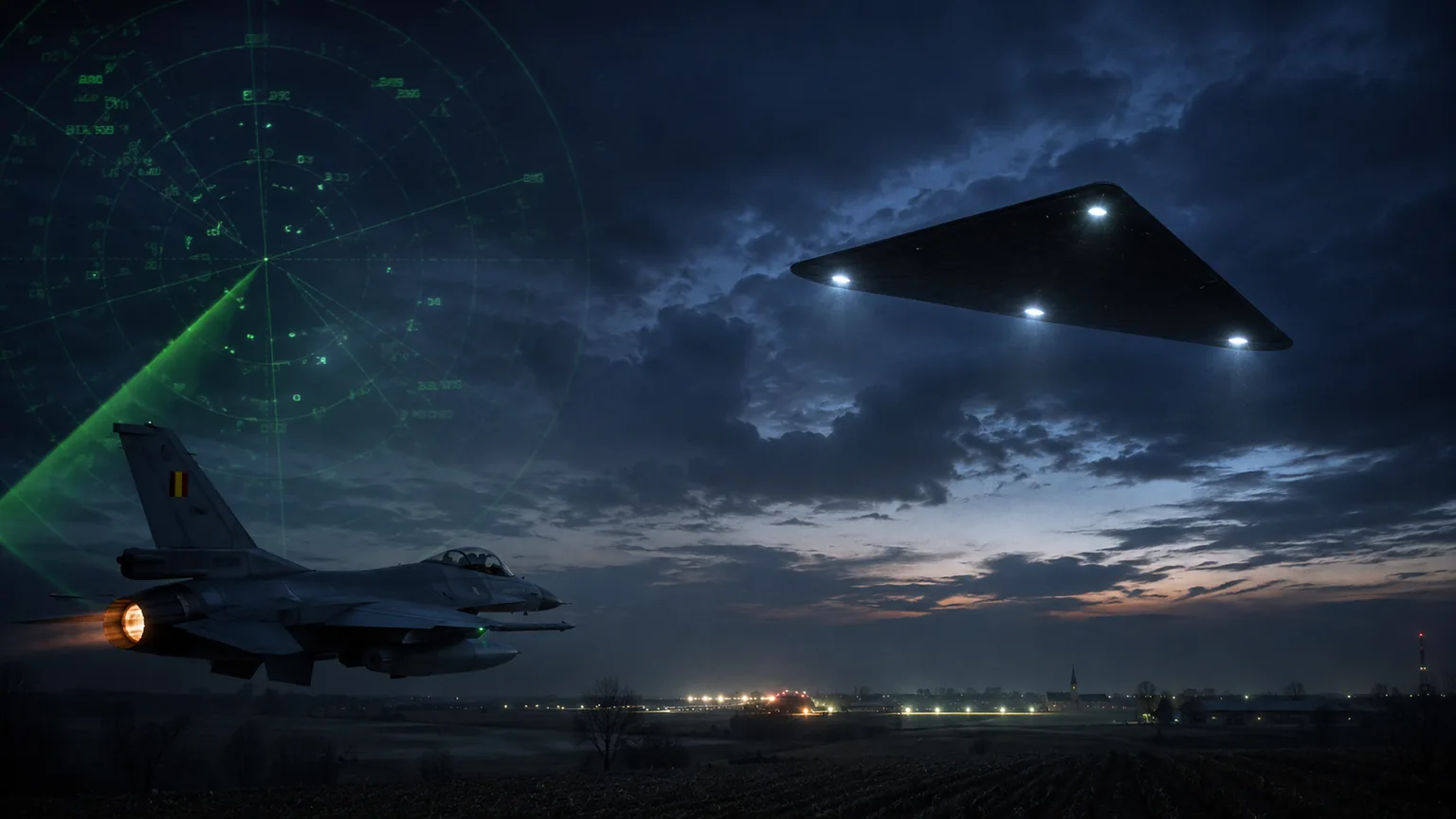
On November 5, 1990, at 6:58 p.m. precisely, on a strip that crosses France from the southwest to the northeast, the autumn sky lit up. Thousands of people - motorists, farmers returning to the fields, flight crews, gendarmes on patrol - see a V or triangle light formation, composed of 3 to 7 shiny points, followed by a long orange streak. Slowly. Silently.
The phenomenon crosses French airspace during approximately 90 seconds. It is observed simultaneously in Brittany, Île-de-France, Burgundy, Lorraine, and Alsace. Several crews ofAir Inter andAir France immediately report their presence by radio. Gendarmes are reporting it from 28 departments.
The SEPRA standard explodes, then silence
At the time, the French organization in charge of unidentified aerospace phenomena was called the SEPRA (Atmospheric Reentry Phenomena Expertise Service), attached to CNES in Toulouse. Its director, Jean-Jacques Velasco, saw his telephone switchboard submerged in the hour that followed. Several hundred calls, in less than two hours.
The next day, AFP, France Inter, Antenne 2, TF1 — all the editorial offices have the same information: “A luminous object was observed above France”. The evening editions open on it. Daily life The Parisian headline on November 6: “Curious phenomenon in the skies of France”. The regional press, Dauphiné Libéré au Brest Telegram, lists local observations.
Within 24 hours, SEPRA gives a first public explanation : this is the reentry into the atmosphere of the 3rd stage of the Soviet Proton-K rocket who had, the previous night, put the Soviet military satellite Gorizont into orbit. NORAD (North American Aerospace Defense Command) confirms. The object has been cataloged: NORAD ID 20925.
What the orbital data shows
The 3rd stage of the Proton-K rocket, after releasing its payload into high orbit, falls back towards Earth following a ballistic trajectory. Its re-entry, this November 5, 1990 at 6:58 p.m. UT, follows an axis which passes exactly above France, from the southwest to the northeast, at a descending altitude of 80 to 40 km. The object has a mass of several tons; it disintegrates into several luminous fragments during re-entry.
This trajectory is perfectly coherent with the observations of witnesses:
- V shape = main fragments which broke off in flight and which follow each other at variable distances.
- Bright orange = compatible with the atmospheric ionization of a metallic object on re-entry at ~7 km/s.
- Silent = compatible with altitude (40-80 km, above the stratosphere).
- 90 seconds = compatible with the re-entry speed and the distance crossed.
✓ Confirmed orbital facts
- Proton-K launch from Baikonur, October 23, 1990, Gorizont mission.
- 3rd floor NORAD #20925, fallout predicted on November 5, 1990.
- Start time: 6:58 p.m. UT (officially cataloged).
- Trajectory: France from southwest to northeast, compatible axis.
Why it took CNES 30 years to recognize its mistakes
The “Proton-K re-entry” explanation, however, took time to establish itself in the collective mind. Several reasons:
- Careful initial communication. In 1990, SEPRA only mentioned the "rocket fragments" hypothesis without naming the rocket diplomatically (USSR still a military ally of NATO on certain issues, end of the Cold War).
- The “UFO” effect on witnesses. Many people have described the object as a "ship" ou "platform" — what the emotional reading of the event encourages, but which does not correspond to observable physics.
- The sociologist Pierre Lagrange (CNRS) published a detailed analysis of the phenomenon in 1993, demonstrating how vision of atmospheric re-entry is systematically reconstructed by witnesses according to cultural grids (vessel, structure, intentional light).
En 2020, on the occasion of the 30th anniversary of the event, GEIPAN (which succeeded SEPRA) publishes a summary note on its site geipan.fr, in which it explicitly recognizes:
“The orbital elements of the 3rd stage of the Proton-K rocket (NORAD #20925) are perfectly compatible with the French collective observation of November 5, 1990. Public communication at the time was not sufficiently clear on this point. »
GEIPAN — summary note, November 2020
This is, in practice, the first explicit recognition by the official French agency that part of the general public's "UFO" file is in reality a "orbital debris reentry" file. A fundamental distinction in the scientific pedagogy of UAP (unidentified aerospace phenomena).
What the November 5, 1990 case does not eliminate
The resolution of November 5, 1990 does not close the overall file of observations in France. GEIPAN continues to archive, each year, approximately 600 to 800 testimonies — of which 3 to 5% are classified “D” (unidentified despite investigation). The rigor of the methodology is increasing: multiple testimonies, radar data, photometric analyses.
⚠ Important distinction
- November 5, 1990 is identified — it’s a Proton-K reentry. This file should be considered closed.
- Other French sightings remain unidentified, notably certain military radar cases (Civil Aviation, Air Force) which have never received a conventional explanation.
- The mix between cases identified but publicized and the cases unidentified is one of the main sources of public confusion on the UFO/UAP subject.
November 5, 1990 remains, in practice, the educational reference case in France to explain how an atmospheric re-entry can, in the absence of clear information, trigger a national social and media phenomenon.
Sources and further reading
- GEIPAN — Summary note on the event of November 5, 1990, November 2020 — https://www.cnes-geipan.fr/
- NORAD Two-Line Elements Catalog — Item #20925 (Proton-K 3rd stage) — https://celestrak.org/NORAD/elements/
- Pierre Lagrange (CNRS) — “The Rumor of Orléans” and the Sociology of UFO Sightings, 1993-2020 (various articles)
- Jean-Jacques Vélasco — “UFO, the obvious”, Robert Laffont, 2007 (SEPRA director at the time)
- Le Parisien — edition of November 6, 1990, national coverage
- Antenne 2 / France 2 — INA archive, newspaper of November 6, 1990 — https://www.ina.fr/
- National Gendarmerie — report of findings, November 1990 (archived at GEIPAN)
- National document “UFOs in the skies of France” — Air Force and Air Force, CNES archives