1977: the creation of GEPAN in Toulouse
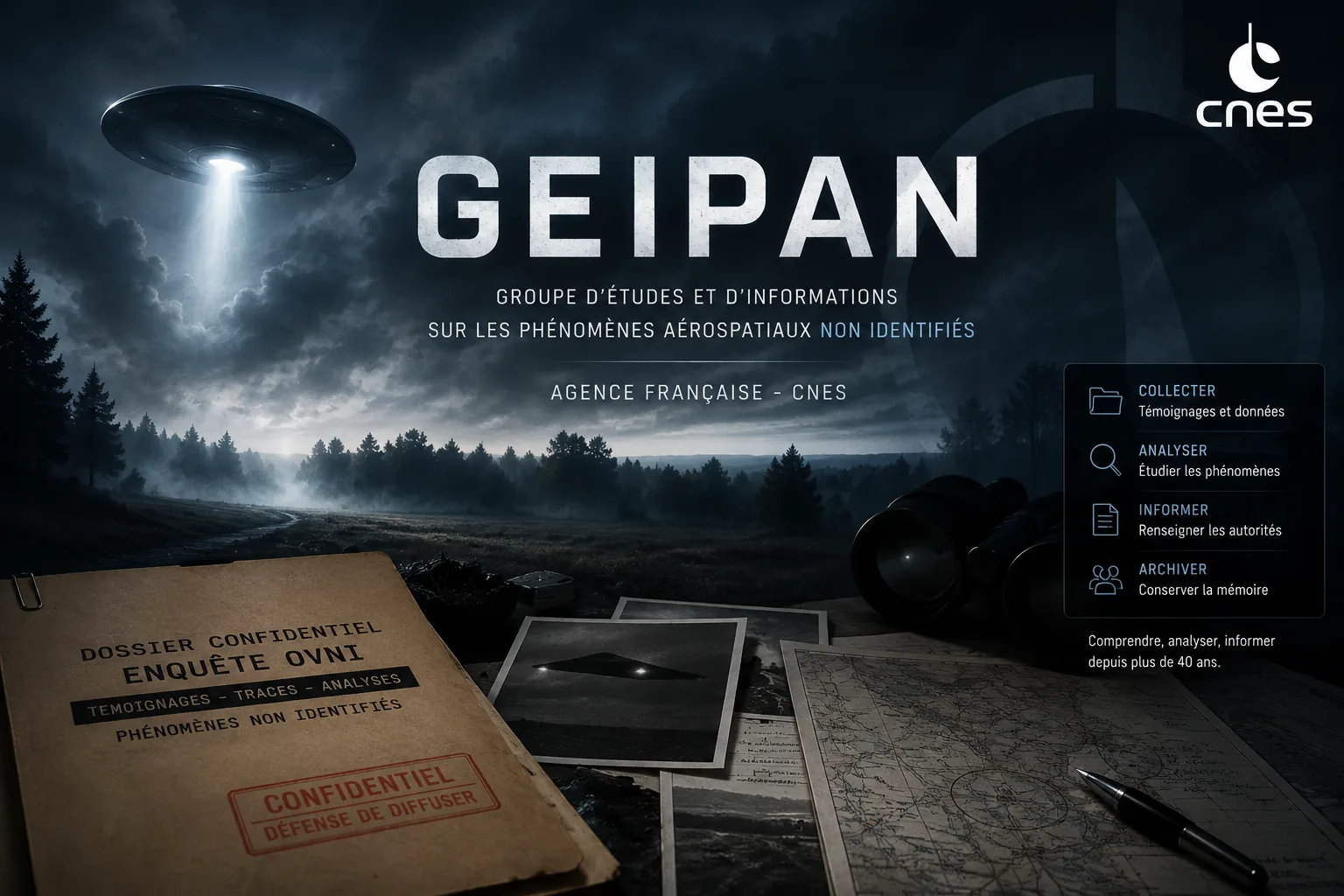
On May 1, 1977, the National Center for Space Studies (CNES) inaugurated a new department in Toulouse, the GEPAN — Unidentified Aerospace Phenomena Study Group. Its first director, engineer Claude Poher, is an astronomer trained at the École Polytechnique, trained at the CNRS and the ballistics department of the CNES.
This creation is unique in the world: no other power has a public body, attached to its space agency, dedicated to the study of observations of unidentified aerospace objects. The United States had the Project Blue Book (USAF, 1952-1969), closed eight years earlier. The United Kingdom had a UFO desk at the Ministry of Defense, but without a public scientific dimension. France is making the opposite bet: an open, scientific, published service.
The initial mandate of GEPAN, validated by the CNES board of directors, is threefold:
- Collect testimonies of UAP (unidentified aerospace phenomena) observations on French territory.
- Analyze these testimonies with a rigorous scientific methodology.
- Publish findings transparently.
GEPAN → SEPRA → GEIPAN: three names, one mission
The organization has had three successive names, reflecting the evolution of its scope:
The SEPRA period (1988-2005) corresponds to an expansion of the mandate: in addition to observations of unidentified objects, the service takes charge of the expertise of atmospheric reentry of space debris on French territory. This skill will be valuable: it is SEPRA which will identify, in 1990, November 5 as the re-entry of a Proton-K stage (see our dedicated article).
In 2005, under the leadership ofYves Sillard (then director), the organization is renamed GEIPAN. The “I” for “Information": the public communication mission becomes central. It was from 2007 that GEIPAN published online, on geipan.fr, all of its investigation files — still unique in the world for an official body.
The methodology: A/B/C/D classification
Each testimony that reaches GEIPAN — via the national gendarmerie, civil aviation (DGAC), the Air Force, military radars, or directly via online form — is analyzed according to a public methodology in four categories:
Of the ~600 to 800 testimonials received each year, the typical distribution is:
- Class A: ~30% — Iridium satellite, ISS, balloon, plane, shooting star, star, planet Venus, Thai lanterns.
- Class B: ~30% — probably an identified phenomenon, but without formal certainty.
- Class C: ~35% — insufficient data to conclude (only one witness, no precise duration, no independent witnesses).
- Class D: 3 to 5% — unexplained despite thorough investigation.
⚠ The real meaning of "Class D"
A class D case does not mean not “evidence of extraterrestrial origin”. This means: after full investigation, none of the known natural hypotheses can be proven. D classes remain open — they can be reclassified if new elements appear.
The iconic cases treated by GEPAN/GEIPAN
A few Class D files have made the scientific reputation of the organization:
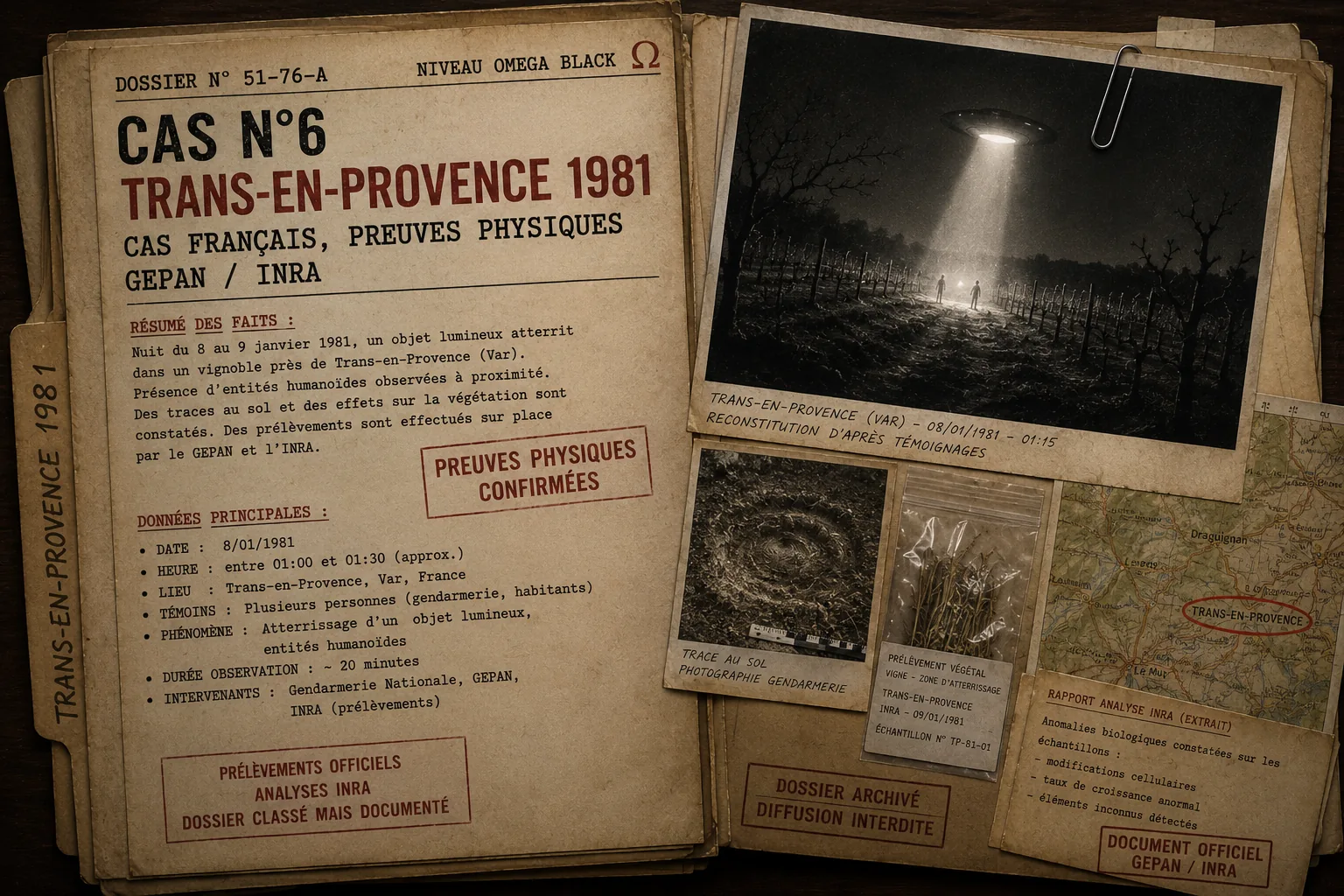
Trans-en-Provence (January 8, 1981)
Renato Nicolaï, mechanic, sees a gray metallic object landing in his garden in Trans-en-Provence (Var). The object takes off a few seconds later. GEPAN, alerted by the gendarmerie, took soil samples and burned plants. The analyses, partly carried out at the INRA phytopharmacology laboratory, show biochemical changes in chlorophyll in alfalfa leaves around the site. The investigation concluded that “a phenomenon of unknown origin deposited a mass of 4 to 5 tonnes on the ground”. Class D.
Cussac (August 29, 1967)
Two children herding cows see a metal sphere land, then four “beings” emerge. The brother and sister (13 and 9 years old) give a corroborated account, without prior history. The cows are found panicking. GEPAN resumed the investigation in 1978, ten years after the events. Class D.
Valensole (July 1, 1965)
Maurice Masse, a farmer, sees an ovoid object on his lavender grove and two humanoid entities. The soil is analyzed: it reveals chemical modifications and a delayed growth of lavender on the landing zone for several years. Class D.
✓ What makes these cases exceptional
- Witnesses identified, without psychiatric history.
- Material samples available (soil, plants, fragments).
- Scientific analyzes published in institutional frameworks (INRA, CNES, university laboratories).
- Conclusions of analyzes which cannot be reduced to a proven conventional explanation.
Who GEIPAN works with — the institutional ecosystem
GEIPAN does not work alone. It relies on a network of institutional partners who transmit their data to it:
- National Gendarmerie : any soldier or civilian witness reporting a UAP establishes a report by the gendarmerie. These minutes are transmitted encrypted to GEIPAN. More than 20,000 reports have been archived since 1977.
- Directorate General of Civil Aviation (DGAC) : transmits reports made by commercial pilots and air traffic controllers.
- Air and Space Force : transmits atypical radar detections when they are declassifiable.
- Météo-France : consulted to interpret unusual weather phenomena.
- CNES Toulouse : scientific support, orbital calculation, identification of atmospheric reentry (skill inherited from SEPRA).
- National Police : for areas not covered by the gendarmerie.
- NORAD through international cooperation : orbital elements of satellites and debris.
This institutional integration distinguishes GEIPAN from private or associative organizations (Belgian SOBEPS, American MUFON, British Strange Phenomena Investigations). In France, the official reporting of a PAN goes through a sworn agent.
The geipan.fr site: transparency as a method
Since 2007, GEIPAN has put online on geipan.fr all of its investigation files. To date, more than 1,700 cases are publicly available, with:
- The initial gendarmerie report (anonymized).
- The investigation elements collected (additional testimonies, technical analyses).
- The A/B/C/D classification and justification.
- Photographs, maps, reconstructed trajectories when they exist.
This policy of transparency is deliberate. It has several objectives:
- Allow scientific criticism : any independent researcher can verify the GEIPAN analysis.
- Avoid conspiracy theories : there is nothing hidden, everything is published.
- Pedagogy : show that 95 to 97% of reports have an identifiable conventional explanation.
- Scientific research : allow statistical aggregation on unexplained cases.
The current director of GEIPAN, Vincent Costes (since 2023), has confirmed in several interviews that this transparency policy will be maintained and extended. GEIPAN remains, in 2026, the only official organization in the world dedicated to the study of UAPs still in activity.
✓ Why GEIPAN matters for the UFO/UAP debate
- It proves that a State can conduct a serious investigation on the subject without falling into ridicule.
- It provides a rigorous statistical framework: 3 to 5% of unidentified cases, no more, no less.
- It serves as a model for more recent initiatives — notably theAARO of the Pentagon (2022) which is openly inspired by the French methodology.
- It keeps open a file that many other countries have preferred to close.
Sources and further reading
- GEIPAN — official public site, complete database of archived cases — https://www.cnes-geipan.fr/
- Claude Poher — “Unidentified Aerospace Phenomena”, 1977 (GEPAN founding report)
- Yves Sillard — “Unidentified Aerospace Phenomena — A Challenge to Science”, Le Cherche-Midi, 2007
- Jean-Jacques Vélasco — “UFO, the obvious”, Robert Laffont, 2007
- GEPAN 1981 report — Technical note n°16 on Trans-en-Provence (CNES, accessible to researchers)
- CNES — GEIPAN institutional files, organization and mandate — https://cnes.fr/
- AARO — All-domain Anomaly Resolution Office, mention of the GEIPAN methodology — https://www.aaro.mil/
- INA — RTBF / France 2 audiovisual archives on GEIPAN, 1977-2024