The morning of November 9, 1979
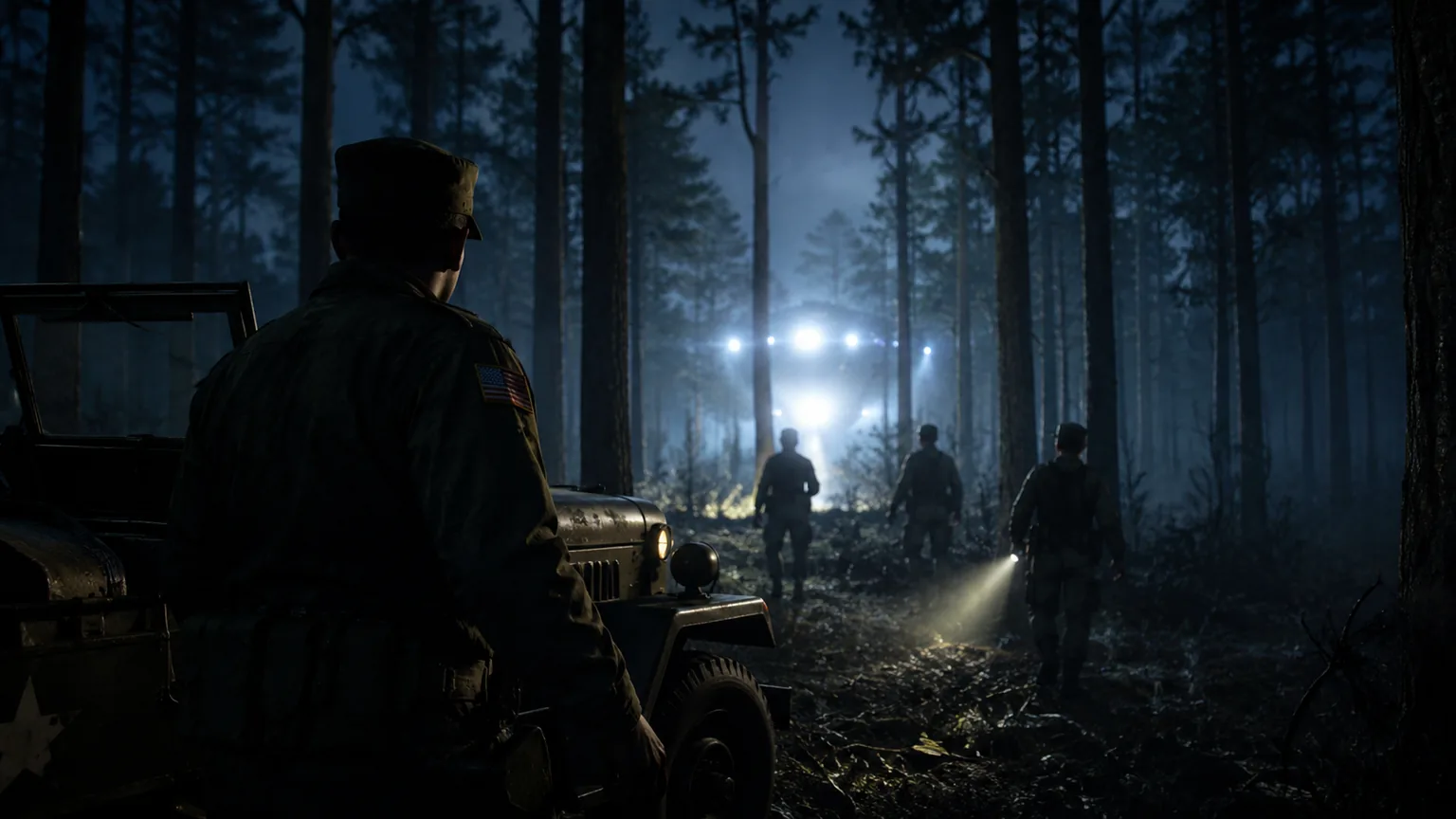
Friday November 9, 1979, around 10:15 a.m. Robert Taylor, 61, forestry officer in the service of Livingston Development Corporation, parks his Land Rover on a path on Dechmont Law, a wooded hill on the edge of the new town of Livingston, 25 km west of Edinburgh. Taylor is a man everyone knows: married, practicing Methodist, former soldier, never had a psychiatric history, never drank alcohol. He has 27 years of experience in the forest and hunting. No one around him describes him as imaginative.
That morning, he walks up the trail with his dog Lara, an Irish Setter, to inspect a clearing. 25 meters from his Land Rover, in a small open-air area among the fir trees, he stops.
The object and the two spheres
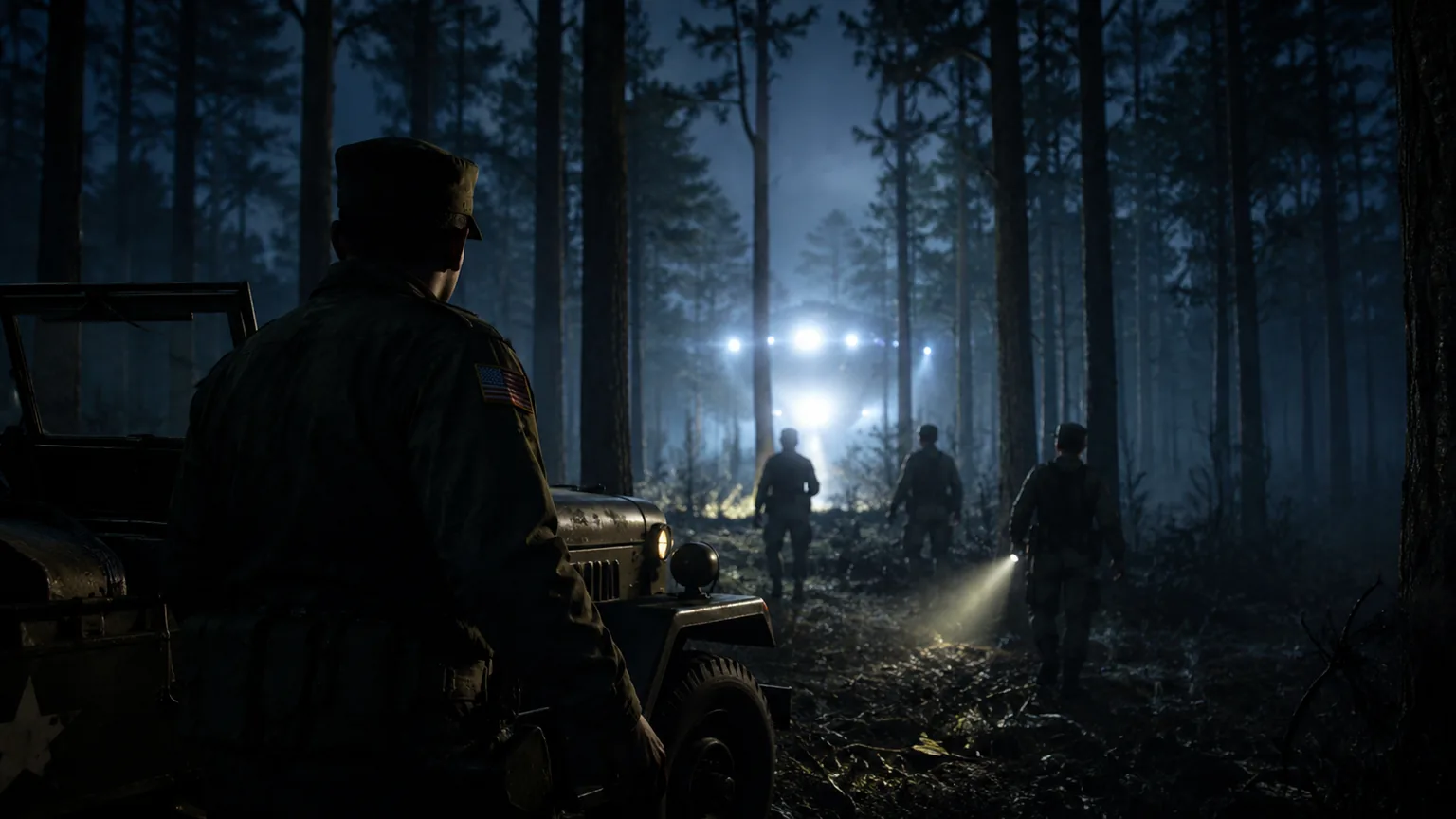
In front of him, about twenty meters away, Taylor sees a large dark gray metal dome, approximately 6 meters in diameter, placed on the ground – or more precisely, suspended just above it. Its surface is rough, almost matte, as if textured in places, transparent in others like a veil which would make the object partially invisible. No noise. No identifiable smell at first.
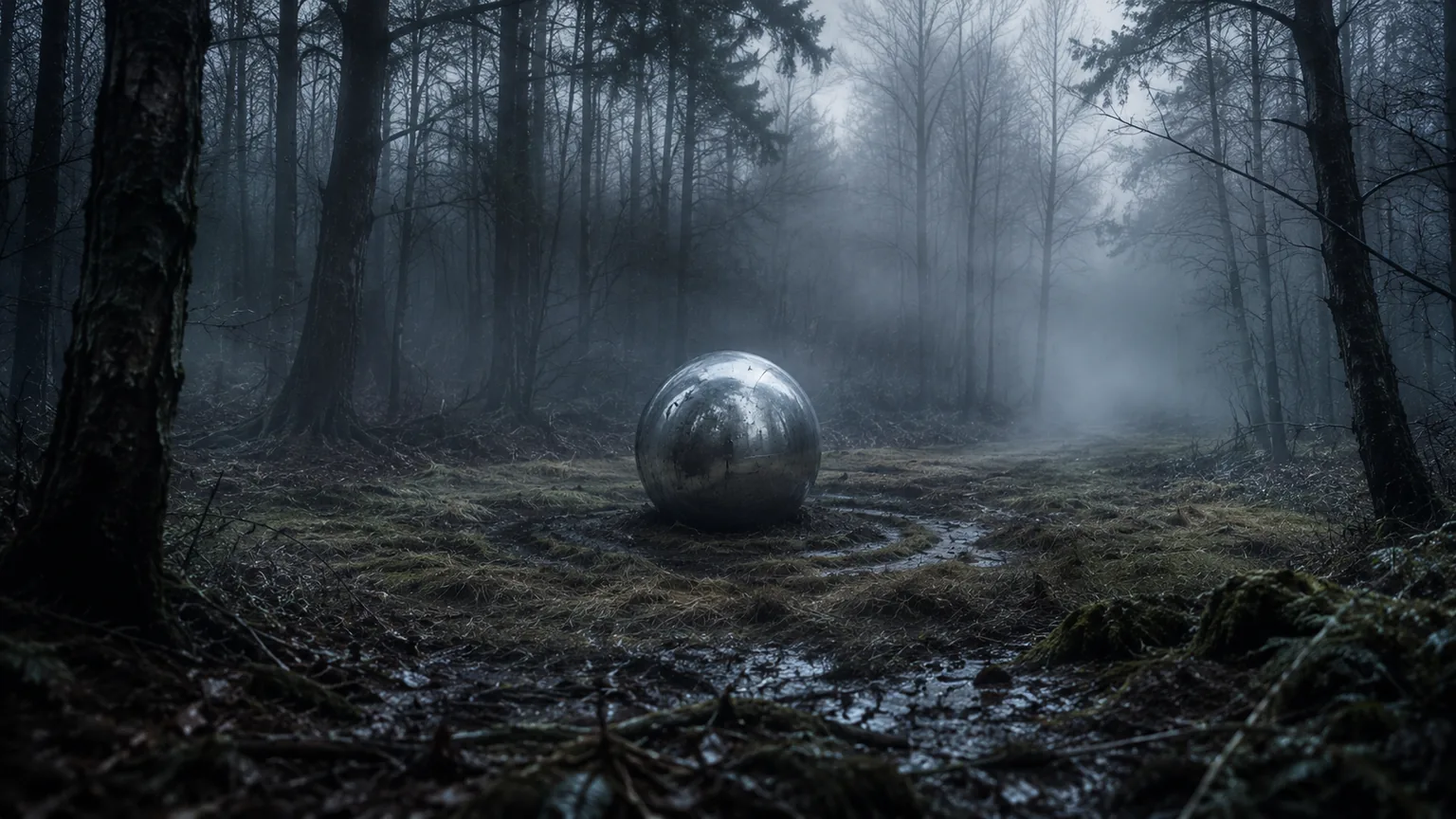
As he watches, two little metal spheres approximately 1 meter in diameter stand out from the main object. They are bristling with protuberances - Taylor speaks of "spikes" like sea mines. They roll towards him on the ground, at a moderate speed.
Two of these quills attach to the sides of his pants, near the hips. Taylor feels that we shoot towards the dome. A pungent smell, “like a burning cable,” rises. He loses consciousness.
“I felt like I was being pulled. Something grabbed my legs. A burning smell came up. And then nothing more. »
Robert Taylor — statement taken by Lothian & Borders Police, November 9, 1979
Waking up, returning, examining
When Taylor regains consciousness, he is alone. Neither the object nor the spheres are there. His watch, his dog, his Land Rover — it's all there. He tries to get up, can't, crawls towards the car. The Land Rover's radio no longer works. He walks home the last part of the way, staggering.
His wife, who saw him arrive, described him as "white, his pants torn, blood on his chin". She calls the doctor and the police. The doctor Gordon Adams, general practitioner in Livingston, notes:
- A wound on the chin (probable fall).
- Of bruises on thighs, at the height of both sides of the pants — precisely where the “quills” are attached.
- Of tears in both pant legs, at the same height, which could not have been made by a branch (the tears are symmetrical, parallel, and the fabric is stretched upwards).
- No signs of stroke, no neurological signs, no poisoning.
✓ Documented physical elements
- The pants is kept as an exhibit. It is today exhibited at Livingston Museum.
- Bruises are noted in Dr. Adams' medical file.
- The smell of burning on the jacket is confirmed by his wife and the constable.
The police open a criminal case: the only known case
The element that makes the Taylor affair unique in the history of unidentified aerial phenomena played out in the hours that followed. When the Lothian & Borders Police constable arrives, he takes Taylor's statement and then goes to the scene. He finds there:
- An area of trampled and deformed ground approximately 20 feet in diameter — the circular mark is the "dome" Taylor described.
- More than 40 regular round holes in the ground, depth ~10 cm, as if a structure had rested on "feet".
- Two parallel lines in the earth, starting from the central area, spaced ~80 cm apart, like rolling marks.
Police believe Taylor was physically assaulted by attackers — he has wounds, traces of torn fabric, and his testimony is consistent. In the absence of identifiable attackers, and since the Scottish penal code allows an "assault by unknown persons" to be investigated without a suspect, the constable formally opens a criminal case for assault.
It is, to date, the only UFO incident in the world legally treated as a crime by a police force. The file was never closed.
Field investigation and natural hypotheses ruled out
The area is quickly cordoned off. The Major Malcolm Drummond, of the police, is supervising the investigation. A botanist from the University of Edinburgh was consulted to examine the traces. An agricultural engineer from East of Scotland College of Agriculture analyzes the displaced earth.
The following hypotheses are formally tested and discarded :
- Agricultural machinery. No tractor can produce 40 regular round holes 10 cm deep arranged in a circle. No tire tracks reach the clearing.
- Forestry work. No team intervened on the plot. The LDC confirms in writing.
- Animal. No animal in Scotland tears pants symmetrically on both legs leaving the fabric stretched upwards.
- Weather/imbalance. Taylor has no neurological history. The doctor rules out stroke, epilepsy, hypoglycemia.
- Directed by Taylor. Taylor is known for his seriousness. He has nothing to gain — refuses any interviews for years, gets no money.
⚠ What the investigation could not establish
- The exact material origin of the traces on the ground.
- The identity or nature of the “attackers”.
- The exact mechanism of the bruises on Taylor's legs.
The file remains open to the criminal register, in the absence of a proven conventional explanation.
45 years later: what has become of the affair
Robert Taylor continued his work as a forester until his retirement. He never sought to exploit the affair and refused almost all television requests. He died in 2007, at age 88, without ever having changed a single line of his initial testimony.
In 2007, the West Lothian Council installed a commemorative plaque at the location of the incident — also unprecedented for a UFO case. The path leading to the site is officially marked "Robert Taylor — UFO Incident Site".
The pants are exposed to Livingston Museum, accompanied by police documentation. The plaque reads in English: "On this site, on the 9th November 1979, a forestry worker, Robert Taylor, reported an encounter with an unidentified flying object."
The Glasgow sociologist Steve Bruce and the Scottish author Malcolm Robinson (Strange Phenomena Investigations) have each published detailed analyzes of the case. The two converge on one point: no element suggests a hoax, no element proves an extraterrestrial origin. The file remains exactly as it always was — a case of unexplained assault treated as a criminal case by a state police force.
Sources and further reading
- Lothian and Borders Police – initial statement and investigation report, 9-12 November 1979 (regional public archives)
- Malcolm Robinson, Strange Phenomena Investigations — “UFO Case Files of Scotland”, Healings of Atlantis, 2010
- Steve Bruce, University of Aberdeen — sociological analyzes published in British Journal of Sociology
- Livingston Museum — “Robert Taylor Trousers” exhibit, associated police documentation — https://www.westlothian.gov.uk/livingston-museum
- West Lothian Council — official memorial plaque, Dechmont Law (installed 2007)
- BBC News Scotland — retrospective coverage of the case (40th anniversary, 9 November 2019) — https://www.bbc.com/news/uk-scotland-edinburgh-east-fife-50338414
- The Scotsman — archive articles 1979-1980 and retrospectives 2009, 2019
- Daily Record — initial coverage November 11-12, 1979