The essentials in 30 seconds
What is established: in early July 1947, debris was recovered from the Foster ranch near Roswell (New Mexico); on July 8, the army announced a “flying disc” then amended the same day to a “weather balloon”. What the official documents say: the 1994 USAF investigation attributed the debris to Mogul project, a secret balloon program to monitor Soviet nuclear tests; the 1997 report attributes the "bodies" accounts to parachuted test models in the 1950s. What remains debated: the reliability of late testimonies, the contradictions of the initial press release, and the absence of certain contemporary archives. No official document establishes the recovery of a device or body of non-human origin.
What Happened: The Documented Sequence
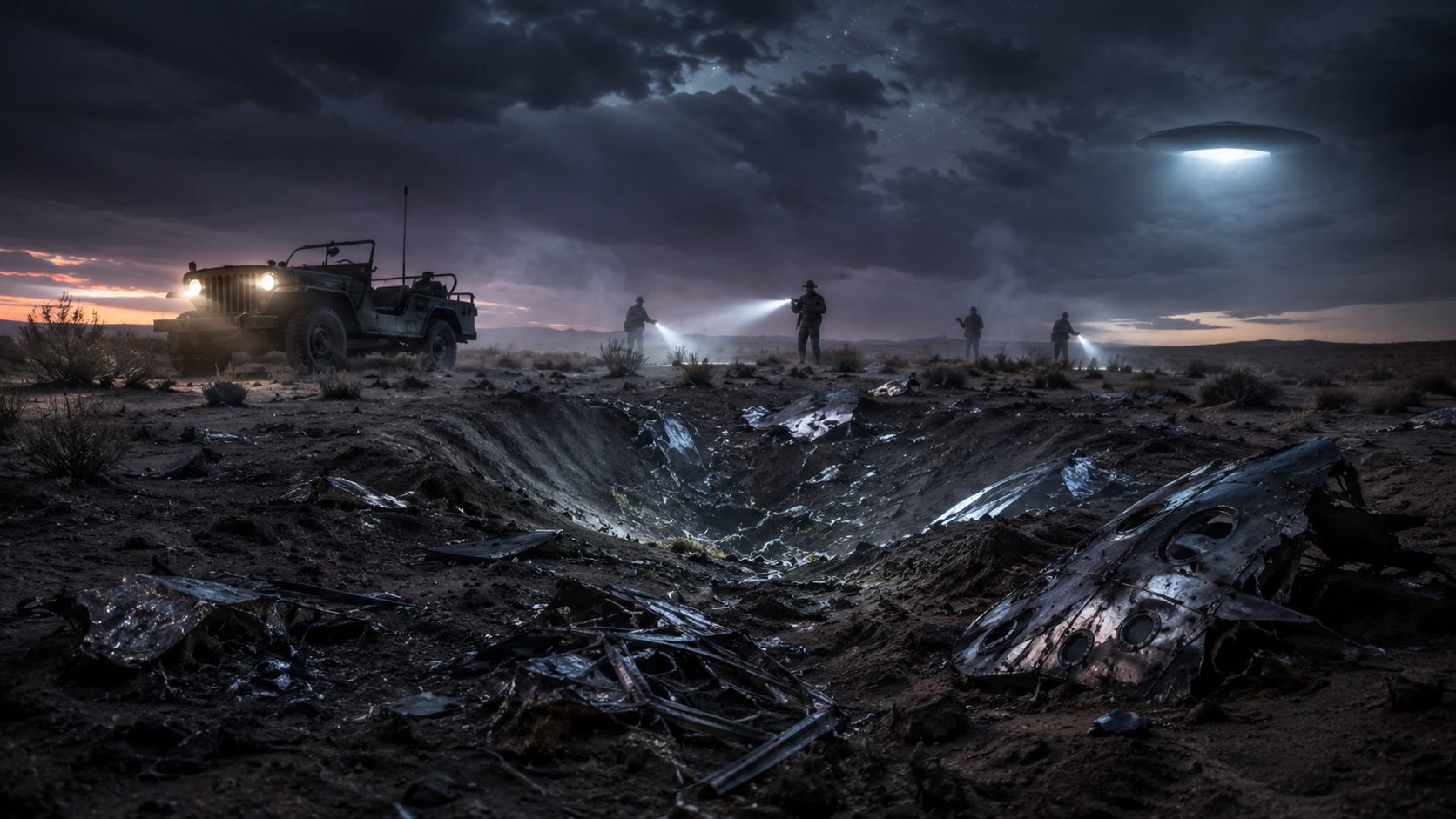
Late June/early July 1947: Intense rainstorm hits Lincoln County, New Mexico. The July 7, Mac Brazel, breeder at the Foster ranch, discovered debris scattered over approximately 1.2 km² in a field. The debris includes pieces of a lightweight, highly durable material similar to reinforced aluminum foil — which springs back into shape after deformation — and sticks with hieroglyphics on them.
Le July 8 at 5:26 p.m., the information office of Roswell Army Air Field (RAAF) issues the following press release:
“The many rumors regarding the flying disk became a reality yesterday when the intelligence office of the 509th Bomb Group of the Eighth Air Force, Roswell Army Air Field, was fortunate enough to gain possession of a disk through the cooperation of one of the local ranchers and the sheriff's office of Chaves County. »
— Official RAAF communiqué, July 8, 1947, broadcast by the Associated Press
It is this press release, written by Lieutenant Walter Top and approved by Colonel William Blanchard, Commander of the RAAF, who initiated the Roswell Affair.
The counter-order: “weather balloon”
A few hours after the initial press release, Brigadier General Roger Ramey, commander of the 8th Air Force in Fort Worth (Texas), holds a press conference and presents debris that he identifies as that of a Rawin sensor weather balloon. Photos taken that day show Ramey and Brigadier-General Thomas DuBose holding the remains of a metal balloon and its radar reflector.
The major Jesse Marcel, an RAAF intelligence officer who had inspected the site and recovered the debris, would declare decades later that the debris presented at Fort Worth were not the ones he had recovered. Marcel will be one of the first witnesses to speak publicly, in the 1970s, during the resurgence of interest in Roswell.
⚠ The central question of the substitute
If the debris presented in Fort Worth was indeed a weather balloon, why did the RAAF first issue a press release referring to it as a “flying disc”? A weather balloon is immediately identifiable to any basic technician—let alone an intelligence officer from the 509th Bomb Group, the unit that dropped the atomic bombs on Hiroshima and Nagasaki two years earlier.
The 1994 USAF report: Project Mogul
In 1994, the General Accounting Office (GAO) — at the request of Representative Steven Schiff (New Mexico) — mandates the USAF to conduct a comprehensive investigation. The report, “The Roswell Report: Fact versus Fiction in the New Mexico Desert” (995 pages), was published in 1994.
Main conclusion: the debris was that of the Project Mogul, a classified high-altitude balloon program intended to monitor Soviet nuclear tests via infrasound. Train 4 (Flight 4) of Mogul balloons is found missing from the archives — it matches the dates and geographic area.
✓ What the report establishes
- Project Mogul was classified in 1947 — hence the impossibility of giving the real explanation to the public.
- The "unusual" materials (aluminum radar reflectors with symbols) correspond to Mogul components.
- Mogul Flight 4 is not found in the records — consistent with a crash in Roswell.
✗ What the report doesn't solve
- Mac Brazel and Jesse Marcel both described materials that did not correspond to a balloon: abnormal mechanical resistance, springback, unknown inscriptions.
- The 1994 report does not address the evidence of recovered bodies — the USAF published a second report in 1997 to explain them (crash test dummies, High Dive program). These mannequins were not introduced until 1953 — six years after the fact.
- The GAO found that RAAF records for the period July 1947 had been destroyed — outside of normal detention procedures.
What GAO records revealed
The 1994 GAO investigation provided access to records that no civilians had seen. Among the discoveries:
- The RAAF administrative logbooks for July 1947 were destroyed on an unknown date, outside legal conservation procedures.
- RAAF incoming and outgoing communications for the same period were “permanently destroyed” according to an Air Force memo.
- RAAF Signals Office archives: destroyed.
The GAO concluded in its 1995 report that these destructions were irregular but that their reason can no longer be established. For an incident whose official version is "a simple weather balloon", the systematic disappearance of RAAF archives for the period concerned has fueled 78 years of speculation.
Sources and further reading
- USAF — The Roswell Report: Fact versus Fiction in the New Mexico Desert, 1994 (995 p.) — https://www.af.mil/
- USAF — The Roswell Report: Case Closed, 1997
- General Accounting Office — GAO/NSIAD-95-187: Results of a Search for Records Concerning the 1947 Crash Near Roswell, New Mexico, July 1995
- RAAF communiqué, July 8, 1947 — Associated Press archives
- Charles Moore — Project Mogul, History of Physics Newsletter, AIP
- Karl Pflock — Roswell: Inconvenient Facts and the Will to Believe, Prometheus Books, 2001
- Stanton Friedman, Don Berliner — Crash at Corona, Marlowe & Company, 1992