Why acronyms proliferate in this file
The UFO/UAP file has become, since 2017, a very dense institutional and bureaucratic terrain. Government agencies, military programs and parliamentary hearings have produced a technical lexicon that the mainstream media often uses without explanation. This guide clarifies the most common terms.
UAP — Unidentified Aerial Phenomena
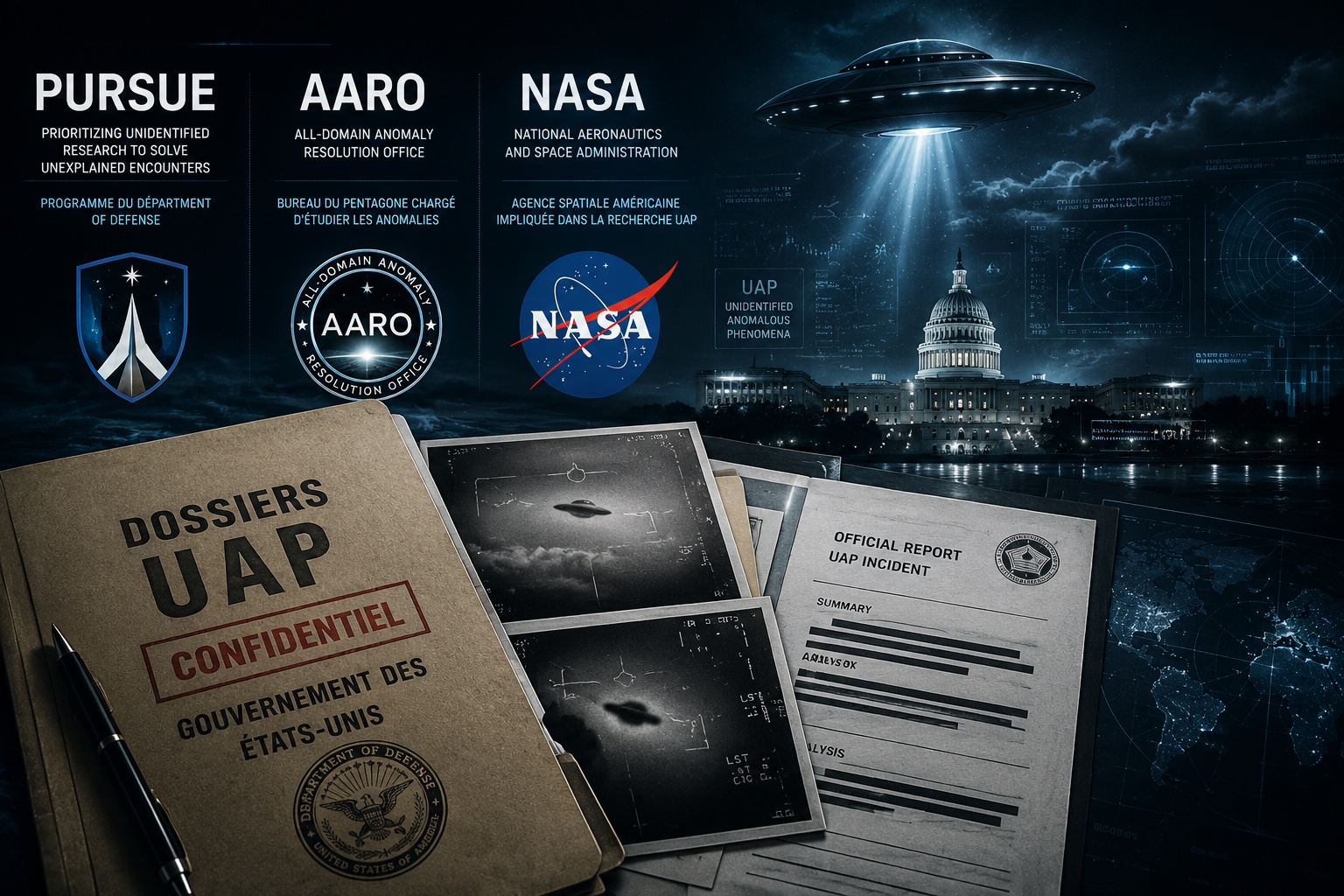
UAP (Unidentified Aerial Phenomena) is the official term adopted by the Pentagon, NASA and the American Congress to designate what the general public calls UFO. The change in terminology dates back to 2020.
Reasons for the change: The term "UFO" was seen as too culturally charged — it immediately evoked science fiction imagery. “UAP” is neutral and describes precisely what we observe: an aerial phenomenon whose origin is not established.
Note: since the NDAA 2023, the official term has further evolved towards UAP ou Non-cooperative UAS depending on the context, but "UAP" remains the most used in public documents.
AARO — All-domain Anomaly Resolution Office
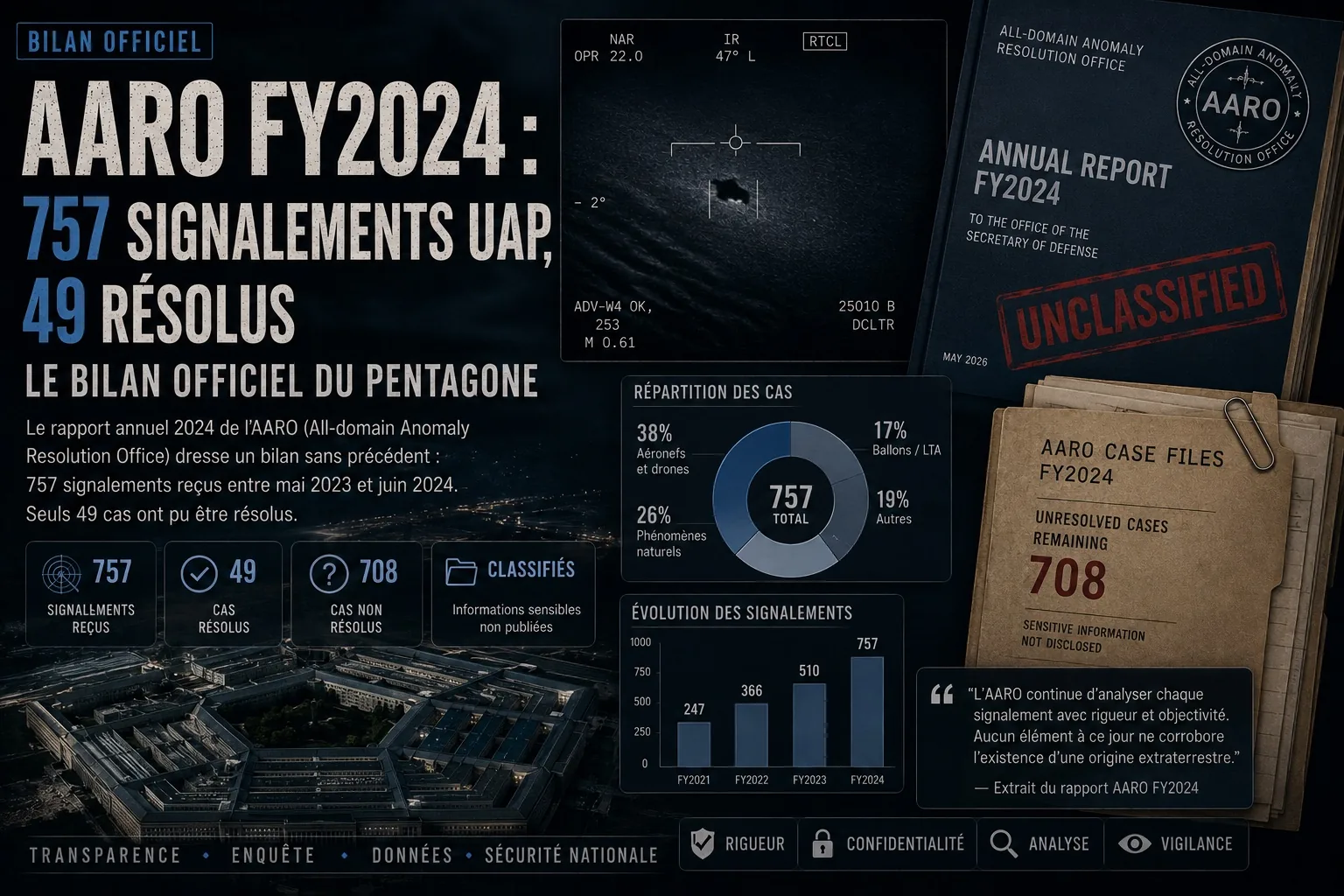
AARO (All-domain Anomaly Resolution Office) is the official Pentagon office responsible for detecting, identifying and attributing anomalous objects and phenomena in the air, maritime, underwater and space domains.
- Creation : July 2022, by the National Defense Authorization Act 2022.
- Mandate : centralize reports from all American military branches, coordinate analysis, produce public annual reports.
- Director : The Director of AARO reports directly to the Secretary of Defense and the Director of National Intelligence.
- Published reports : FY2022, FY2023, FY2024 — available on aaro.mil.
- Main limit : AARO does not have the legal mandate to access all classified programs — some fall under other agencies (CIA, NSA).
PURSUE — the publication program May 2026
PURSUE is the official designation of the proactive UAP file publication program implemented by the Department of War in 2026, via the WAR.GOV/UFO platform. Two installments were published: May 8 and May 22, 2026.
Unlike previous declassifications (often linked to leaks or legal decisions), PURSUE is a planned institutional mechanism for publication. The files are selected, annotated and posted online according to a schedule communicated in advance to Congress.
NASA — why the space agency is involved
La NASA (National Aeronautics and Space Administration) is not a defense agency — its involvement in the UAP issue is specific and limited.
- In June 2022, NASA formed a independent UAP study team of 16 researchers, led by David Spergel (cosmologist, Princeton).
- Their report, published on September 14, 2023, concludes that there is insufficient data to identify the origin of UAPs, and recommends a rigorous scientific approach.
- NASA has named a first UAP director (Dr. Mark McInerney, 2024) and opened a portal science.nasa.gov/uap.
- NASA's mandate in this matter is scientific and civil — it does not coordinate with AARO on classified aspects.
Other common acronyms
Sources used
- DoD/AARO — Official website aaro.mil, reports FY2022, FY2023, FY2024. Official definitions and mandates.
- National Defense Authorization Acts 2021, 2022, 2023 — Clauses relating to UAPs, creation of the UAPTF then the AARO.
- NASA — UAP Independent Study Team Report, September 14, 2023. Available at science.nasa.gov/uap.
- WAR.GOV/UFO — PURSUE program, official description of the publication mechanism.
- Office of the Director of National Intelligence — “Preliminary Assessment: Unidentified Aerial Phenomena”, June 2021.