5:11 p.m. — The two objects in formation
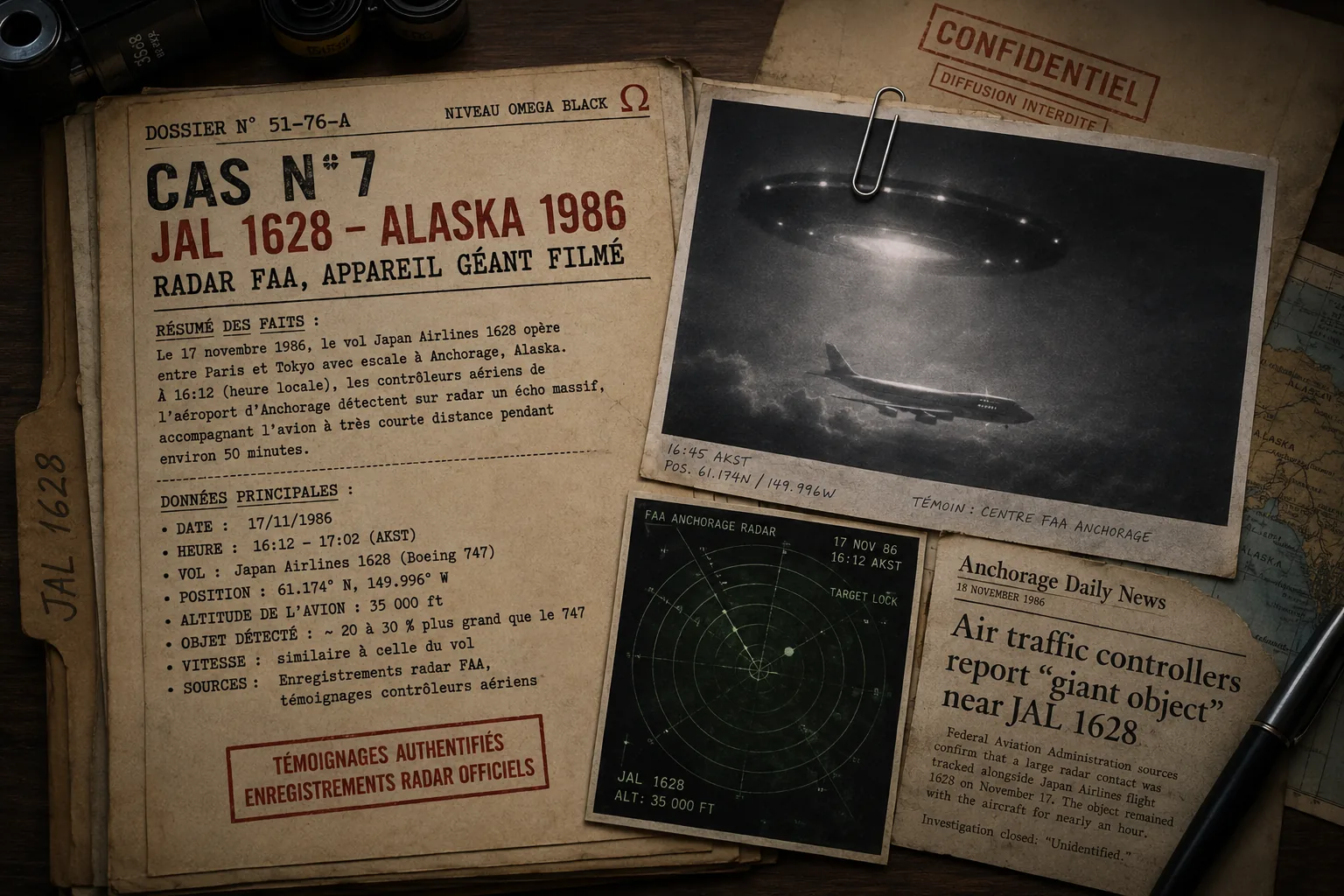
On November 17, 1986, JAL flight 1628 — a Boeing 747-200F freighter — operated the Reykjavik (Iceland) – Paris – Anchorage (Alaska) route. At 5:11 p.m. local time, approximately 340 km southwest of Anchorage, altitude 11,000 meters, Commander Kenjyu Terauchi, his co-pilot Takanori Tamefuji and mechanic Yoshio Tsukuda see two luminous objects in front of them, slightly below.
The objects emit flashing yellow-amber and white lights, arranged in two rows of four lights each — “like packets of light.” Terauchi first thinks of military planes. He reports the presence as he approaches Anchorage.
The object the size of two aircraft carriers
After about 10 minutes, the two small objects disappear. A third object appears — this time facing the plane, very close. Terauchi describes it as twice as large as the USS Enterprise aircraft carrier (335 meters long), or approximately 700 meters in diameter. The object is circular in shape, with lights around its edge.
Terauchi requests a route diversion as he approaches Anchorage to get away. The approach contacts the Military Radar Unit of Elmendorf AFB — operators confirm secondary contact on their radars.
“The machine flew as if it were playing with us. When we slowed down, he slowed down. When we accelerated, he accelerated. I would like to emphasize: this object was of colossal size. »
Source document (EN): “The thing was flying as if it were toying with us. When we slowed down, it slowed down. When we sped up, it sped up. I want to stress this object was huge. »
— Commander Kenjyu Terauchi, press conference, March 1987
FAA investigation — radar data released
The Federal Aviation Administration opens a formal investigation. The FAA's regional director in Alaska, Paul Steucke, held a press conference in March 1987 and published radar data and radio transcripts of the incident - something extremely rare.
FAA investigation results:
- La Anchorage FAA obtained radar contact at the position reported by Terauchi at 5:19 p.m. for approximately 2 minutes, then lost contact during an antenna rotation.
- The military radar ofElmendorf AFB got a secondary contact (skin paint — direct echo, without transponder) at a position consistent with the observation for a few scans.
- La NORAD was alerted and sent a fighter plane — the object was missing on arrival.
⚠ Limitations of radar data
Radar contacts were intermittent. Some experts have suggested atmospheric reflections (ducting). However, the object was simultaneously visible visually by three crew members and partially confirmed by radar — a combination that makes atmospheric hypotheses alone insufficient.
Terauchi's credibility — and its consequences
Kenjyu Terauchi was one of Japan Airlines' most experienced pilots at the time: 29 years of service, more than 10,000 flight hours, formerly a fighter pilot in the Japan Self-Defense Forces. He had no psychiatric history or disciplinary incidents.
After going public with his testimony, Terauchi was temporarily removed from long-haul flights by Japan Airlines — a move he interpreted as punishment related to the publicity surrounding the incident. He was reinstated on international flights the following year.
✓ Why this case matters
- Three professional aviation witnesses on the same aircraft.
- Civil and military radar contact confirmed (partial but real).
- The FAA has released its data — this is one of the cases where a US government has made its UFO radar data public.
- Terauchi maintained his testimony until his death in 2004.
Sources and further reading
- FAA — radio transcripts and radar data JAL 1628, published by Paul Steucke, March 1987
- John Callahan (former head of the FAA R&D division) — public statements about the incident — https://nuforc.org/
- Commander Kenjyu Terauchi — written report and press conference, March 1987
- NICAP — detailed analysis of the JAL 1628 case — https://nicap.org/
- Leslie Kean — UFOs: Generals, Pilots and Government Officials Go On Record, Harmony Books, 2010
- Jerome Clark — The UFO Book, Visible Ink Press, 1998