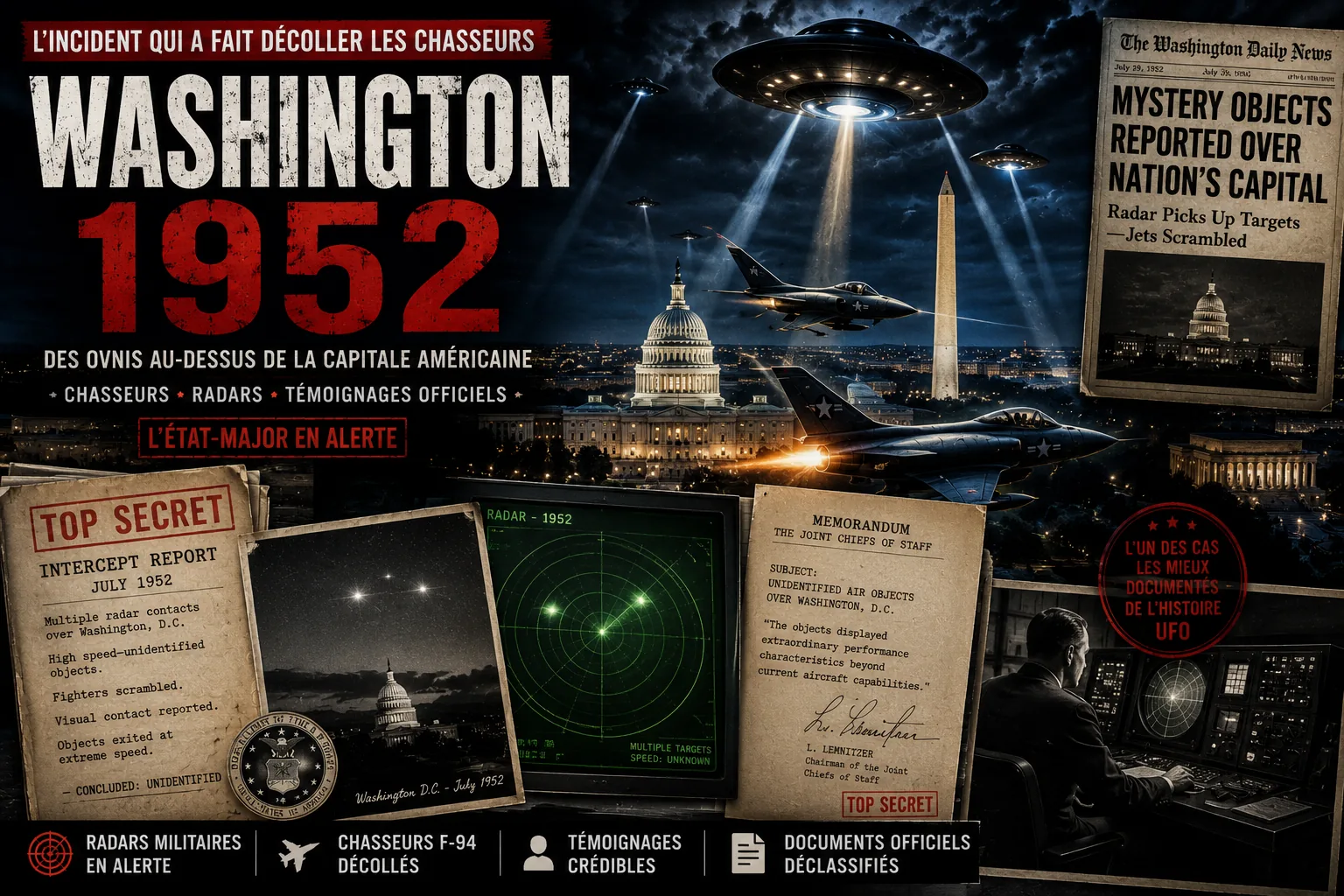
The night of July 19, 1952: unknown targets on seven radars
It was around midnight when Harry Barnes, senior air traffic controller at the Washington Air Route Traffic Control Center (ARTCC) at Washington National Airport, detected seven unidentified targets on his primary radar. The objects initially move slowly — between 130 and 200 km/h — then suddenly accelerate to speeds estimated between 1,000 and 12,000 km/h.
Simultaneously, similar targets are detected on the Washington National Airport radar (operated by CAA), on the Andrews Air Force Base radar, and by Andrews Tower controllers. Seven independent radar systems confirm the presence of objects in the restricted airspace of the federal capital.
Several of the objects pass directly over the White House and Capitol — absolute no-fly zones. The situation is immediately reported to the air defense command.
F-94 fighters: an impossible interception
F-94 Starfire fighters are scrambled from New Castle (Delaware) and Andrews bases. Pilots receive radar coordinates of targets.
Each time an interceptor approaches, the objects accelerate and disappear. Many pilots report seeing bright lights moving away at speeds their aircraft cannot keep up with. When the fighters, running out of fuel, leave, the targets reappear on the radars.
One pilot, Lieutenant William Patterson, reported being surrounded by several bright lights that he could neither identify nor intercept. He asks for authorization to open fire. Permission is refused — the objects do not appear threatening and the situation in the capital's airspace is too complex.
The second wave, on July 26 and 27, reproduced exactly the same patterns: multiple radar detections, unsuccessful interceptions, objects disappearing as the fighters approached.
The Pentagon press conference: the largest since 1945
On July 29, 1952, Major General John Samford, director of Air Force Intelligence, held a press conference at the Pentagon. It was the Air Force's largest news conference since the end of World War II.
Samford confirms that the radar targets are real — he does not deny the detections. He proposes the official hypothesis of an atmospheric thermal inversion: particular weather conditions could create false radar echoes, and city lights could appear as aerial objects.
However, several radar controllers and pilots dispute this explanation. Harry Barnes, who operated the main radar, emphasizes that thermal inversions do not explain targets performing sudden accelerations or impossible maneuvers for atmospheric phenomena. Pilots who observed the lights visually also ruled out weather effects.
The conference does not end the debate — it intensifies it.
Official documents: Joint Chiefs, CIA, Robertson Panel
In the days following the incidents, a memorandum was sent to the Joint Chiefs of Staff. The document, signed by General L. Lemnitzer, underlines the exceptional nature of the events and the need for a thorough investigation.
The CIA, alerted by the wave of July 1952 — the largest ever recorded up to that point in the United States — convened the Robertson Panel in January 1953: a group of scientists responsible for assessing the UFO threat. This panel recommends a policy of minimal declassification and public education aimed at reducing reporting.
Project Blue Book opens a formal investigation into the July 1952 incidents. The official conclusion remains: thermal inversion and atmospheric effects. Ruppelt, director of the Blue Book, does not entirely agree with this conclusion in his memoirs published after his retirement.
Captain Edward J. Ruppelt, who coined the term "UFO", would later write that the Washington 1952 incidents were the most difficult cases to explain in the entire history of Project Blue Book.
Civilian and military witnesses: what they said
Harry Barnes, Senior Controller: “These objects were real. They weren't radar ghosts. We tracked them on several independent systems. Some of them moved at speeds that no aircraft of the time could achieve. »
Joe Zacko, controller at Andrews Tower: described visually observing a bright object above the base, corresponding to the radar targets.
Lieutenant Patterson, F-94 pilot: “I saw the lights. They were moving too fast for me to follow. I've never seen anything like this in my career. »
All of these testimonies, from professional aviation personnel accustomed to aircraft identification, are documented in the Project Blue Book archives and in Ruppelt's memoirs.
The thermal inversion hypothesis: a contested explanation
Thermal inversion is a real meteorological phenomenon: a layer of warm air above a layer of cold air can create conditions for abnormal propagation of radio waves, generating false radar echoes.
Meteorologists confirmed that a thermal inversion did indeed exist over Washington on the affected nights. This is the central argument of the official version.
However, radar experts dispute that this inversion can explain targets making sudden accelerations, sharp turns, and disappearing as fighters approach — behaviors inconsistent with static or slowly evolving atmospheric echoes.
Furthermore, the consistent visual observations of pilots and controllers cannot be attributed to atmospheric radar effects. These direct visual testimonies have never received a satisfactory explanation in the official archives.
Legacy: Washington 1952, a turning point in UFO history
The July 1952 incidents over Washington are considered by many historians of the UFO phenomenon to be a breaking point. For the first time, unidentified objects violated America's most protected airspace, in front of multiple radar and visual witnesses, with no conventional explanation universally accepted.
These events led directly to the creation of the Robertson Panel (CIA, 1953), which defined American UFO policy for the following decades: minimizing media coverage, reducing public reporting, and maintaining a low level of classification.
Seventy-two years later, the Washington 1952 incidents are still cited in debates over government transparency regarding UAPs — notably during U.S. Congressional hearings in 2023.
Frequently asked questions
Were the Washington 1952 UFOs detected on just one radar?
No. The objects were tracked simultaneously on seven independent radar systems: radars at ARTCC, Washington National Airport, Andrews Base, and by several tower controllers. This multi-sensor correlation is one of the strongest elements of the file.
How fast did the objects reach on the radars?
Estimates vary between 1,000 and 12,000 km/h depending on the controllers and the phases of movement observed. Some objects moved slowly (130 km/h), then suddenly accelerated. These speed profiles are inconsistent with any known aircraft from 1952.
Does thermal inversion explain all the testimonies?
No. If thermal inversion can create false radar echoes, it does not explain the direct visual observations of pilots and controllers, nor the dynamic behavior of targets (sudden accelerations, disappearances when fighters approach).
Why did the USAF hold an exceptional press conference?
The media pressure was considerable. The incident was reported in the national and international press. Major General Samford's lecture was intended to provide an official explanation and reassure the public and airline pilots.
What is the link between Washington 1952 and the CIA’s Robertson Panel?
The July 1952 surge directly led to the CIA convening the Robertson Panel in January 1953. This group of scientists recommended a policy of minimal declassification and reduced public reporting—a policy implemented for decades.
Are the 1952 incidents recognized in current UAP investigations?
Yes. They are cited in several historic US Congressional reports on UAPs as an example of a case with unexplained multiple radar-visual correlation. The corresponding Blue Book archives are publicly available through the U.S. National Archives.
Sources and limits
Sources: Project Blue Book archives (available at the US National Archives), memoirs of Captain Edward J. Ruppelt 'The Report on Unidentified Flying Objects' (1956), depositions of radar controllers Harry Barnes, Joe Zacko and the pilots (Blue Book archives), Joint Chiefs of Staff memorandum (1952), documents of the Robertson Panel (CIA, 1953, declassified). Limitations: Speed estimates vary between radar operators. Partial thermal inversion is a real and documented phenomenon for the nights concerned. Pilot reports are recorded oral statements — not direct recordings. Several Blue Book documents remain partially redacted.