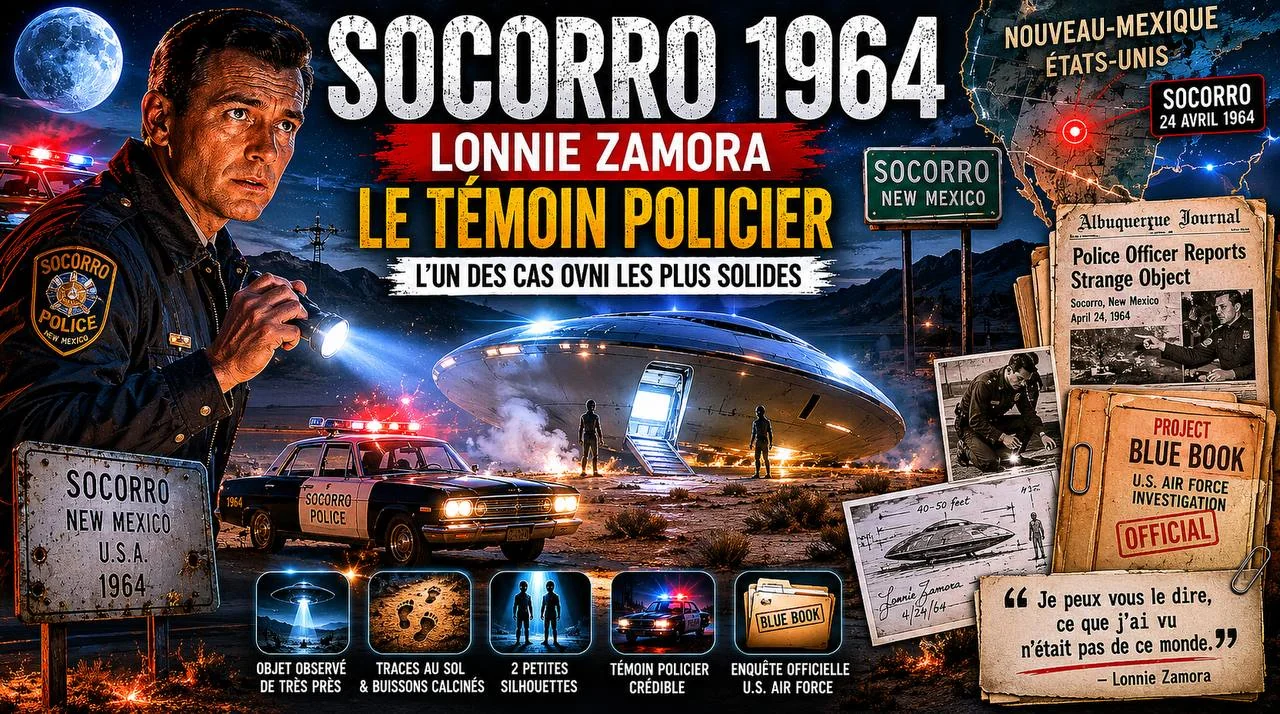
The facts: April 24, 1964, 5:45 p.m.
Lonnie Zamora has been a police officer in Socorro for several years. This Friday evening, he chased a vehicle that was driving too fast north of the city. Suddenly, a blue-orange flame and a dull roar make him turn his head towards the desert. He abandons the pursuit.
What he sees as he approaches: a white, oval or elliptical shaped machine, approximately 5 to 6 meters long, placed on four stabilizers in a ravine. Next to the camera are two short figures wearing white jumpsuits. One of them seems to jump when she sees Zamora approaching.
Before he can get out of the car, the machine emits a roar that quickly increases in frequency. A blue and orange flame bursts out from under the object. The aircraft rises vertically, passes a few meters above the sage bushes, then heads southwest, silently accelerating. Zamora follows it with her gaze until it disappears on the horizon, still at low altitude.
Total duration of observation: less than three minutes. Zamora is less than 40 meters from the craft at the closest moment.
Physical traces: what the investigation found on the ground
Investigators who arrived on scene within the hour found unusual physical evidence.
Ground marks: four rectangular footprints arranged in an irregular square, embedded in the soft ground. Their shape corresponds to stabilizer pads. The surrounding vegetation is burned at several points, concentrically.
Charred bushes: several sage shrubs show traces of recent combustion at the base. Analysis of the burned areas indicates intense heat applied for a short duration — incompatible with an ordinary fire or standard pyrotechnic device.
Soil Analysis: Samples taken by Air Force chemists reveal no known propellant residue, no identifiable chemical contamination. The ground has slight vitrification on the surface in certain places.
Sergeant Sam Chavez, who arrived as reinforcement, confirmed having seen the object moving away from the road. He will be the second official eyewitness.
The official investigation: FBI, Project Blue Book and Air Force
The Socorro case triggers an official response unusual in its scale and speed.
Project Blue Book: USAF program principal investigator Dr. J. Allen Hynek personally travels to Socorro. Hynek, initially skeptical of UFOs, is impressed by the consistency of Zamora's testimony and the presence of physical traces. It classified the case as unexplained in Blue Book's final report — one of the few times the program publicly acknowledged having no answers.
FBI: The Federal Bureau is participating in the initial investigation. The agents questioned Zamora separately, several times, without finding any contradiction in his story. Zamora's psychological profile — stable police officer, no history of irrational behavior, impeccable reputation in the community — works in his favor.
Air Force: several conventional avenues are explored: experimental helicopter, vertical take-off jet plane, weather balloon, lunar test vehicle. None matched Zamora's description or the marks on the ground. NASA confirms that it has no tests planned in the area on this date.
The final Blue Book report on Socorro (file no. 8766) will be one of the largest in the program.
The credibility of Lonnie Zamora
Lonnie Zamora's reputation plays a central role in how this case is handled. Unlike many UFO witnesses of the 1960s, Zamora is not an anonymous civilian: he is a sworn police officer, accustomed to observing and reporting with precision.
Several elements reinforce its credibility in the eyes of investigators.
He reports the incident immediately by radio, without delay. The first colleagues arrive while the tracks are still fresh and the vegetation is lightly smoking.
His story does not vary during multiple interrogations. Hynek notes that Zamora makes no attempt to embellish his testimony and himself expresses sincere confusion about what he saw.
He is not looking for any notoriety. According to his colleagues and journalists who contacted him in the following weeks, Zamora was visibly disturbed by the event and preferred not to talk about it.
Dr. Hynek would later write in The UFO Experience (1972) that the Socorro case was one of the strongest he had ever investigated.
Conventional hypotheses examined
Since 1964, several attempts at a conventional explanation have been proposed. None stood out.
Hoax: considered quickly, dismissed just as quickly. The staging would have required considerable technical resources to reproduce the traces, the burns and the observation of Zamora from 40 meters. No witnesses to a potential hoax have emerged in sixty years.
Experimental helicopter: the American army operated several secret programs in 1964. But no known helicopter can take off vertically with a roar followed by silent flight at low altitude, nor have the oval shape described.
Lunar Module Lunar Vehicle: Proposed in the 2000s as an alternative explanation. This theory doesn't hold up — the LEM doesn't fly in a dense atmosphere, its profile is completely different, and the tests at the time don't match geographically.
Natural phenomenon: atmospheric plasma or fire tornado? Incompatible with the two silhouettes observed and the mechanical structure of the machine.
Hynek sums it up in one sentence: “Either Zamora made it all up or he saw something real. Everything points to the second hypothesis. »
What remains unexplained in 2024
Sixty years after the incident, several points resist any known explanation.
The emblem: on the hull of the machine, Zamora can see a symbol - a sort of arc with vertical lines. The Air Force asked him to draw it. This symbol has never been identified as a marking of any American or Soviet military or civilian program.
The silhouettes: two small beings in white jumpsuits. Zamora describes them as humanoid but specifies that he observes them briefly, from afar. The USAF has never identified any personnel in white overalls present in the area that day.
Silence in flight: the machine which takes off with a roar becomes completely silent in flight. No propulsion technology known in 1964 — nor in 2024 — produces this acoustic profile.
No known fuselage: the white elliptical shape with stabilizers does not match any aircraft listed in declassified American or Soviet archives.
The legacy of the Socorro case in UAP research
The Socorro case has had a lasting influence on the way researchers and institutions treat UFO testimonies.
For J. Allen Hynek, it was partly because of Socorro that he abandoned his initial skepticism and founded the CUFOS (Center for UFO Studies) in 1973. He developed his method of analysis based on objective criteria: consistency of testimony, physical traces, absence of conventional alternative.
The French GEIPAN cites Socorro in its protocols as an example of a physical trace and credible witness case with institutional investigation, a category that warrants in-depth investigation.
In 2022, the Pentagon's UAP Report (AARO) explicitly mentions the importance of incidents with corroborated physical traces — a category to which Socorro belongs.
Lonnie Zamora died in 2009. He maintained his description of the events of April 24, 1964 until the end, without ever changing or withdrawing it.
Frequently asked questions
What did Lonnie Zamora really see in Socorro in 1964?
Officer Lonnie Zamora observed a white oval craft landing in the Socorro Desert, with two figures in white jumpsuits. The object took off with a roar and then sped silently toward the southwest. The FBI and USAF confirmed its credibility and the presence of physical traces.
Has the Socorro case been officially resolved?
No. Project Blue Book classified it as unexplained, one of the few times the program admits to not having an answer. No subsequent investigation has provided a satisfactory conventional explanation.
What physical evidence was found in Socorro?
Investigators found four stabilizer imprints embedded in the ground, charred bushes at the base, and slight vitrification of the ground. Chemical analyzes revealed no known propellant residues.
Why is Lonnie Zamora's testimony considered credible?
Zamora was a sworn police officer with no history of irrationality. His story remained consistent during multiple separate interrogations and he never sought to gain notoriety from it. Dr. Hynek called him one of the best witnesses he ever interviewed.
Has the symbol observed on the machine been identified?
No. Zamora designed the emblem visible on the hull. This symbol has never been linked to any known American or Soviet military or civilian program.
What is the link between Socorro and current UAP investigations?
Socorro is cited in the French GEIPAN protocols and appears in the category of incidents with corroborated physical traces that the Pentagon has integrated into its UAP investigation criteria since 2022.
Sources and limits
Sources used: Project Blue Book report No. 8766 (USAF, declassified); FBI records available via FOIA; J. Allen Hynek, The UFO Experience (1972); NICAP file on Socorro (1964); GEIPAN archives (CNES France); Pentagon AARO report (2022). Limitations: all military archives on Socorro are not declassified. The testimonies rely on a single primary observer (Zamora) and a second partial witness (Chavez). The soil analyzes date from 1964 and cannot be reproduced on the original site.