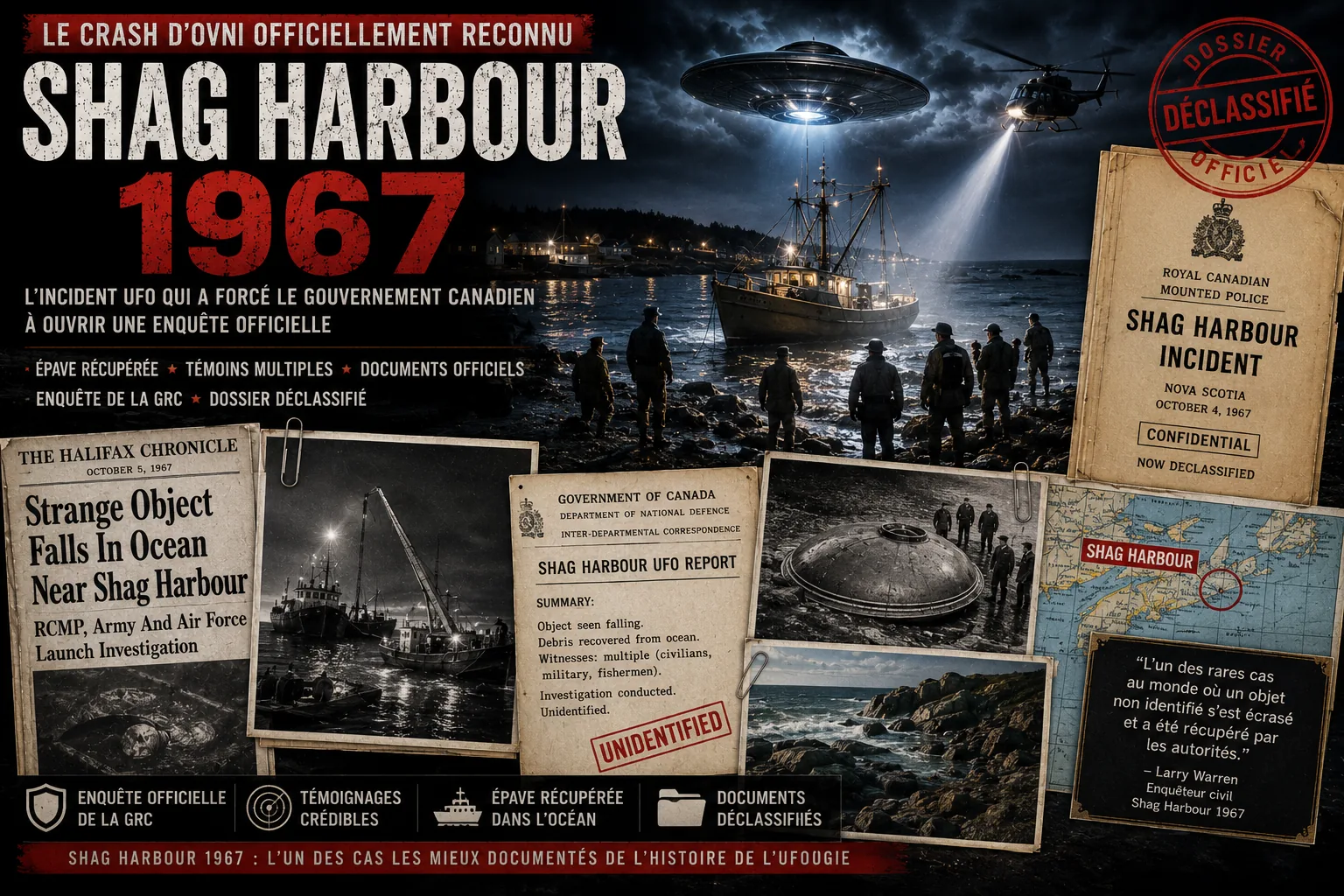
The night of October 4, 1967: an object falls into the ocean
It’s 11:20 p.m. Several witnesses — fishermen, local families, an RCMP officer on patrol — observe a luminous object moving at low altitude above Shag Harbour, a small fishing village on the Atlantic coast of Nova Scotia.
The object has four orange lights flashing in sequence. It descends at an angle, emitting a hissing sound, and hits the surface of the water a few hundred meters from the shore. A flash and a muffled explosion are heard. A yellowish-orange foam or foam appears on the surface, luminous and visible from the coast.
Thinking a plane has crashed, local fishermen immediately set sail to help. They quickly reach the foam on the surface - but find no recognizable debris, no passengers, no cabin. The moss is described as dense, yellow-orange in color, with an unusual appearance.
The RCMP (Royal Canadian Mounted Police) was alerted immediately. An RCMP officer, who himself had observed the object from the road, confirmed the report.
The official investigation: RCMP, Canadian Navy, RCAF
The RCMP opened an investigation on October 5. The authorities contacted NavCan, civil and military air traffic control: no civil or military aircraft were missing in the region. No flight plans are open for the area.
The Royal Canadian Navy deploys research vessels within 48 hours. Military divers conduct dives in the bay. They report observing something on the bottom—a shape—but are unable to reach it or retrieve it. According to certain testimonies from divers mentioned years later, the object had moved underwater before disappearing.
The Royal Canadian Air Force (RCAF) is also involved in aerial searches. The US Navy from the Argentia base (Newfoundland) is cooperating. No conventional debris is recovered.
The Department of National Defense of Canada opens a formal file: MNDOP 9-5-2 (UFO report, Shag Harbour, Nova Scotia, October 4, 1967). This document was subsequently declassified.
The declassified file: unidentified
Canadian Department of National Defense document MNDOP 9-5-2, consulted after declassification, classifies the incident as 'unidentified'. It's a rare designation — most UFO reports receive a conventional explanation (airplane, meteor, balloon).
The report summarizes: object seen falling, debris (foam) recovered on the surface, multiple witnesses including civilians and an RCMP officer, investigation led by the Navy and the RCMP, unidentified object.
Other Canadian government documents about the incident have been made public over the decades. All in all, it confirms that the authorities took the incident very seriously and have not found a satisfactory explanation.
Shag Harbor is one of the few cases in the world where a national government has formally investigated a UFO incident including a crash at sea and officially concluded that identification was not possible.
Witnesses: fishermen, RCMP officer, civilians
Laurie Wickens, 18, was one of the first to observe the object from the coastal road. He immediately alerted the RCMP. His description — four orange lights in sequence, angled descent, impact in water — is confirmed by at least four other witnesses present in his car.
The RCMP officer who received the call himself saw the object from the road before arriving on scene. His testimony as a sworn official is particularly documented in the archives.
Fishermen who put to sea immediately after the impact reached the surface foam. Many describe the foam as luminous and unusual in composition — unlike any known sea foam.
In total, there are between ten and thirty direct witnesses according to investigators' estimates, including civilians, professional fishermen and law enforcement officials.
The underwater hypothesis: an object that would have moved
Several decades after the incident, military divers who participated in the search in 1967 testified publicly — including at a MUFON conference in the 1990s — that they had observed an object moving beneath the surface before disappearing.
These late testimonies, difficult to verify independently, raise the possibility that the object was capable of maneuvering underwater - a behavior which corresponded to what current UAP investigations call a "transmedium vehicle", capable of operating in several environments.
<strong>What is documented:</strong> the impact at sea, the foam on the surface, the official investigation, the classification 'unidentified'. <strong>What remains on the border between testimony and speculation:</strong> the behavior of the object underwater according to military divers, mentioned thirty years after the fact.
Shag Harbor in the context of 1960s UFO investigations
By 1967, the U.S. and Canadian governments had active programs collecting UFO reports. On the American side, Project Blue Book was active. On the Canadian side, the 'Second Storey' program (1952) then 'Project Magnet' (supervised by Wilbert Smith) had laid the foundations for an institutional investigation.
The Shag Harbor incident occurred at a time of transition: the Condon Report (which would lead to the closure of the Blue Book in 1969) was being developed. Political pressure to downplay UFO reports is strong.
Despite this context, Canadian authorities have maintained a serious investigation and refused to offer an unsubstantiated explanation. This institutional rigor sets Shag Harbor apart from most contemporary incidents.
Legacy: Shag Harbor as a benchmark for certified cases
Shag Harbor is today cited in academic and institutional work as one of the best-documented cases involving a physical object, a confirmed impact, and a formal government investigation concluding that identification was impossible.
A local museum in Shag Harbor keeps the memory of the incident alive. Annual conferences were organized in the years 1990-2000. Canadian documentaries covered the story.
In the U.S. Congressional UAP hearings (2023) and AARO work, Shag Harbor is regularly mentioned as an example of a historical case with physical traces and government documentation — the type of case that modern UAP investigation protocols seek to address.
No conventional explanation – meteor, unlisted plane, balloon – has been provided by Canadian authorities since 1967.
Frequently asked questions
Has the object of Shag Harbor been officially recognized by the Canadian government?
Yes. Canadian Department of National Defense file MNDOP 9-5-2 classifies the incident as 'unidentified'. RCMP, Navy and RCAF investigations are documented. This is one of the few cases to carry this official classification.
Was any debris recovered from Shag Harbor?
A yellow-orange foam or foam, described as luminous and of unusual composition, was observed on the surface by first responders and fishermen. No solid debris from conventional aircraft was recovered. Military divers were unable to identify the object on the bottom.
How many witnesses observed the object?
Between ten and thirty direct witnesses according to investigators' estimates, including civilians, professional fishermen, and an RCMP officer who had himself observed the object before being alerted by radio.
Was the incident considered a plane crash?
Initially yes — authorities initially assumed a plane had crashed and mobilized rescue resources. But no civil or military aircraft were missing in the region. The hypothesis of an air accident was quickly ruled out.
Is Shag Harbor one of the transmedia object cases?
The hypothesis is mentioned by certain researchers: late testimonies from military divers suggest that the object could have moved underwater. This behavior fits the 'transmedium' category studied by AARO, but these reports have not been independently verified.
Where to consult official Shag Harbor documents?
Declassified Canadian government documents are accessible via the National Archives of Canada and via the Library and Archives Canada website. The reference file is MNDOP 9-5-2. Several documents were also obtained via access to information requests (ATIP).
Sources and limits
Sources: File MNDOP 9-5-2 (Canadian Department of National Defense, 1967, declassified), Barrington Passage RCMP archives (Nova Scotia), testimonies of civilian witnesses and first responders, MUFON archives (testimonies of military divers, 1990s), documentary 'The Shag Harbor Incident' (Don Ledger & Chris Styles, 2001), Library and Archives Canada. Limitations: The testimonies of military divers referring to the underwater movement of the object appeared late (30 years after the events) and could not be independently verified. The composition of the surface foam has not been the subject of published chemical analysis.