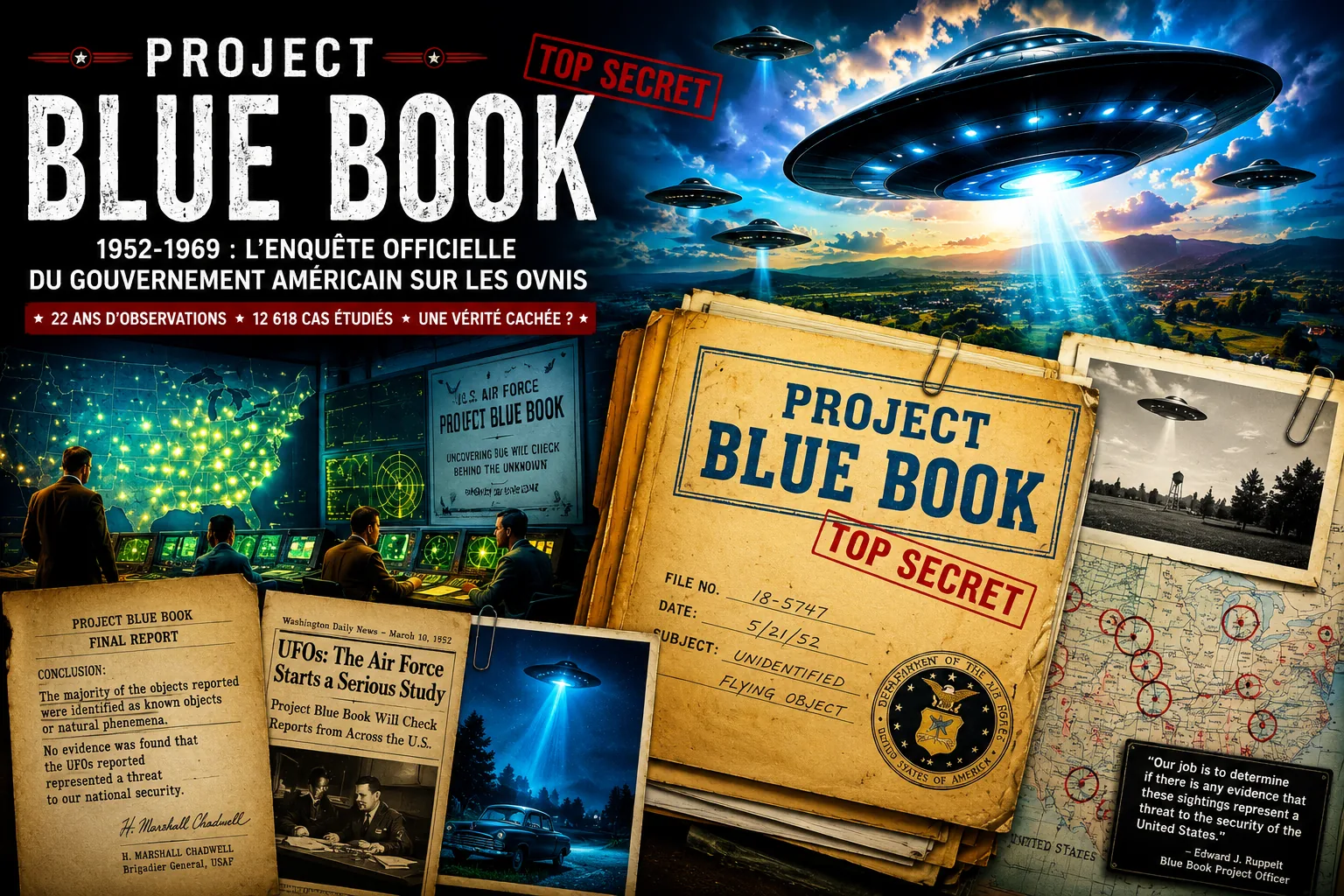
Origins: from Project Sign to Project Blue Book
Project Blue Book is not the first U.S. government UFO investigation program. It was preceded by Project Sign (1947) — opened immediately after the Kenneth Arnold affair and the Roswell crash — and by Project Grudge (1948-1951).
Project Sign produced a secret estimate in 1948—never officially published—suggesting that some UFOs could be of extraterrestrial origin. This document was rejected by General Hoyt Vandenberg, Chief of Staff of the Air Force, who ordered its destruction. Project Grudge was then created with a mandate geared toward debunking.
Project Blue Book was born in 1952 under the leadership of Captain Edward J. Ruppelt, who imposed a more rigorous methodology and created the term 'UFO' (Unidentified Flying Object) - replacing the popular terms 'flying saucer' deemed unscientific.
The program is based at Wright-Patterson Air Force Base (Ohio) and is attached to the Air Technical Intelligence Center (ATIC).
The method: how the cases were investigated
Project Blue Book received the reports through Air Force regional commands. Civilian and military witnesses completed standardized forms. For each case, investigators tried to identify a conventional explanation: military or civilian plane, weather balloon, atmospheric phenomenon, satellite, planet or bright star.
Astronomer Dr. J. Allen Hynek — a professor at Ohio State University — was the program's designated scientific advisor. Initially skeptical, Hynek was tasked with providing astronomical explanations. As the years passed, he became less and less convinced that all the observations could be explained conventionally.
The standard procedure consisted of several steps: collection of the report, questioning of the witness, consultation of weather data and aircraft movements, review by Hynek for astronomical cases, then final classification.
The cases were classified into five categories: known (explanation found), probably known, possible known, insufficient (lack of data), or not identified.
The 701 unidentified cases: what the archives reveal
Of 12,618 recorded cases, 701 — or 5.5% — are officially classified as 'unidentified'. This figure is often cited in debates about government transparency.
Among these 701 cases are some of the most documented incidents in American UFO history: the Lonnie Zamora sighting at Socorro (1964), the Exeter (New Hampshire, 1965) sightings, the Malmstrom AFB incidents (1967), and the Washington events (1952).
Hynek himself indicated that the strongest cases — those with multiple witnesses, radar, and unexplained physical behavior — were consistently among the most difficult to classify. He estimated that the actual proportion unexplained was probably higher than the official 5.5%, due to institutional pressures to maximize conventional explanations.
The complete Project Blue Book archives are available to the public today through the U.S. National Archives and searchable online through the National Archives Catalog.
The Robertson Panel (CIA, 1953): the policy of silence
In January 1953, faced with the influx of reports - the 1952 wave was the largest ever recorded - the CIA convened the Robertson Panel: a group of five scientists (physics, astronomy, radar, weapons) responsible for assessing the UFO threat.
The panel concludes that UFOs do not represent a direct threat to national security, but that the mass of reports constitutes a military communications problem: it clutters alert channels and could be exploited by an enemy to cause information chaos.
Central recommendation: conduct a public demystification campaign to reduce public interest in UFOs, and monitor civilian investigative organizations. This recommendation was partially implemented, influencing the official posture of the Blue Book for the following years.
The Robertson Panel Report was declassified in 1966 and remains one of the key documents for understanding American UFO policy during the Cold War.
Hynek: from institutional skeptic to founder of CUFOS
Dr. J. Allen Hynek is the central scientific figure of Project Blue Book. A recognized astronomer, he was recruited to bring scientific credibility to the program — and provide astronomical explanations for complex cases.
In the early 1950s, Hynek was skeptical and readily offered conventional explanations. He originated the 'swamp gas' explanation for a famous case — an explanation he would later publicly regret.
Over the years, faced with cases that he could not explain despite his efforts, Hynek changed his position. He created the categories of analysis that still structure the field: Close Encounters of the First Kind (simple observation), Second Kind (physical effects), Third Kind (observed beings) — made famous by Steven Spielberg in <em>Close Encounters of the Third Kind</em> (1977), for which Hynek was an advisor.
After Blue Book closed in 1969, Hynek founded the Center for UFO Studies (CUFOS) in 1973 — convincing him that the subject merited serious scientific investigation independent of the military.
The Condon Report and the closure of the program (1969)
In 1966, under pressure from Congress and the public, the Air Force funded an independent study by the University of Colorado, led by Dr. Edward Condon, a respected physicist.
The Condon Report, published in 1969, concluded that the study of UFOs had not yielded any significant scientific knowledge and did not appear likely to yield any in the future. This conclusion allowed the Air Force to close Project Blue Book on December 17, 1969.
However, the Condon report itself is controversial. Members of the research team publicly accused Condon of bias, saying his conclusion was written before the research was completed. Independent analyzes showed that the report's 'unexplained' cases made up about 30% of the total studied — a much higher proportion than the report highlights.
Hynek sharply criticized the Condon report, saying it sacrificed scientific rigor for institutional considerations.
Legacy of the Blue Book in current UAP surveys
Project Blue Book is directly invoked in current debates over government transparency. Congressional hearings in 2022 and 2023 highlighted the limitations of this program as justification for more transparent and independent UAP investigations.
The AARO (All-domain Anomaly Resolution Office), created in 2022, is presented as a response to criticism of the Blue Book: broader mandates, including multi-sensor observations and historical cases.
The 701 unidentified cases in the Blue Book still constitute a reference database for researchers today. Several of these cases — Socorro, Washington 1952, Malmstrom — have been the subject of in-depth analyzes with modern analytical tools, without conventional explanations having been found.
Dr Hynek concluded: 'The UFO problem is not a problem of mass psychology or collective hysteria. This is a scientific problem that deserves serious investigation.' This phrase still resonates in current institutional debates.
Frequently asked questions
How many cases has Project Blue Book handled?
12,618 cases in total, from 1952 to 1969. Of this total, 701 — or approximately 5.5% — were officially classified as 'unidentified'. The complete records are publicly available through the U.S. National Archives.
Who was Dr. J. Allen Hynek and what was his role?
An Ohio State University astronomer, Hynek had been the scientific advisor to Project Blue Book since 1948. Initially skeptical, he gradually changed his stance on cases he could not explain. He created the 'close encounters' categories and founded CUFOS in 1973.
Why was Project Blue Book closed?
The closure in 1969 followed the Condon Report (University of Colorado), which concluded that the study of UFOs did not provide significant scientific knowledge. This report itself was criticized for bias, but it provided the official justification for the closure.
Was Project Blue Book a cover-up?
Internal members, including Ruppelt and Hynek, have both criticized institutional pressures to maximize conventional explanations. The Robertson Panel (CIA, 1953) officially recommended a policy of debunking. These documented elements legitimately fuel questions about the independence of the program.
Are the Blue Book archives accessible?
Yes. The complete Project Blue Book archives have been declassified and are available through the US National Archives Catalog. They are also digitized and available online on the United States National Archives website.
What is the link between Blue Book and current UAP surveys?
Project Blue Book is regularly cited in Congressional hearings as an example of an insufficient investigative program. AARO (created in 2022) has a broader mandate and includes multi-domain data (air, sea, space). The unidentified Blue Book cases provide a historical baseline for current analysts.
Sources and limits
Sources: Complete archives of Project Blue Book (National Archives Catalog, USA), 'The Report on Unidentified Flying Objects' (Captain Edward J. Ruppelt, 1956), 'The UFO Experience' (Dr. J. Allen Hynek, 1972), Condon Report (University of Colorado, 1969), Robertson Panel Report (CIA, 1953, declassified 1966), testimony before the US Congress (2022-2023). Limitations: The Blue Book archives have documentary gaps (missing files, partial redactions). The actual proportion of unidentified cases is debated — some analysts believe that institutional pressure has led to over-classifications as 'explained'. The Condon report itself is disputed by former members of the team.