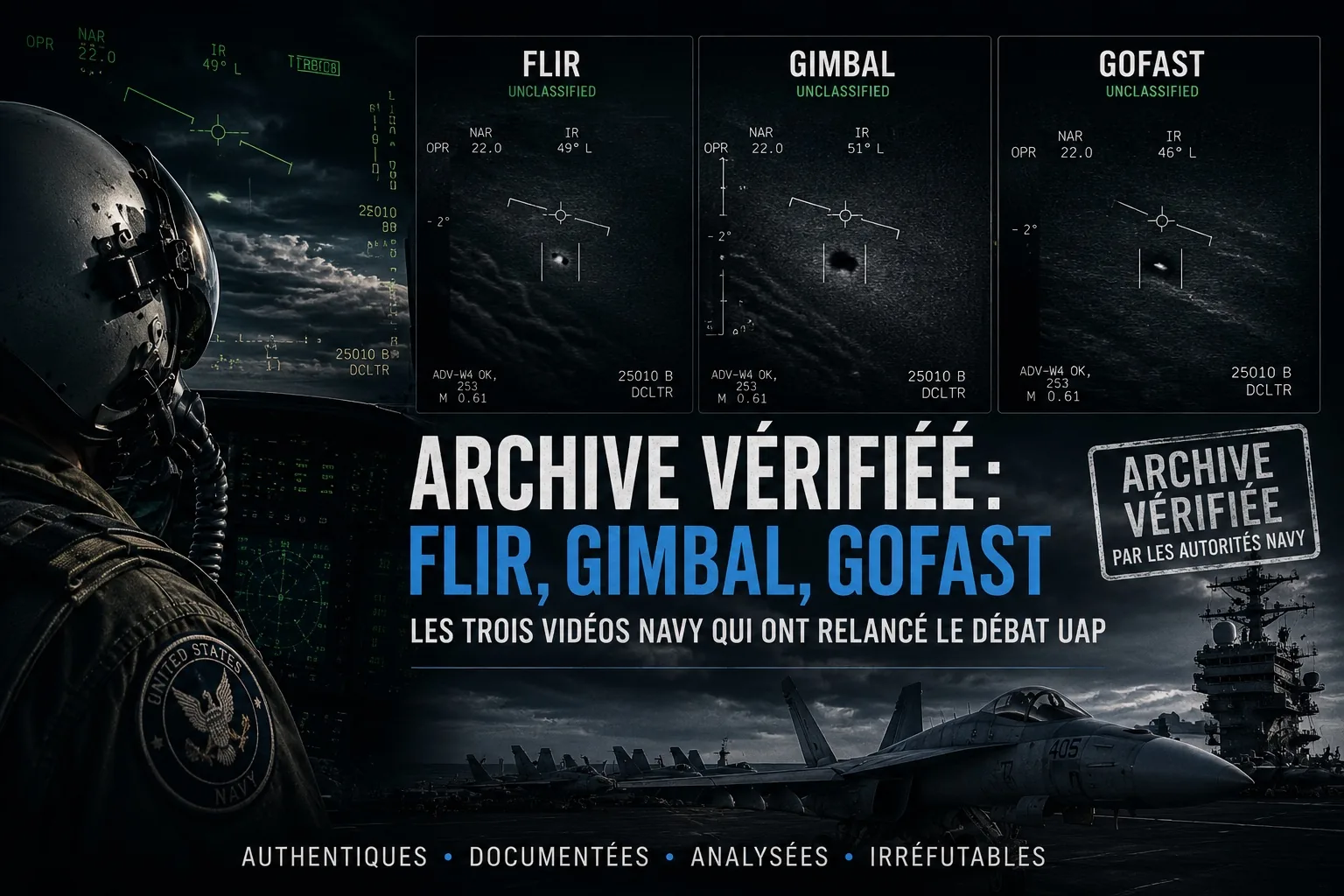
Three videos — a two-step declassification
The three videos known as FLIR1, Gimbal et GoFast are recordings captured by infrared sensors onboard US Navy combat jets. They circulated in two distinct ways:
- December 2017 : unofficial publication by To The Stars Academy of Arts & Science (TTSA) via the New York Times and Politico. The videos are not yet confirmed by the government.
- April 27, 2020 : the Pentagon officially publishes the three videos and confirms their authenticity by press release. Spokeswoman Sue Gough says the Department of Defense authorizes their public release.
What these videos show — and their technical limitations
FLIR1 : captured during the Nimitz incident (USS Nimitz / USS Princeton). An oblong, white object, without wings or visible thermal signature of propulsion, filmed for approximately 1 min 20. The object rotates and disappears from the field of vision. Commander David Fravor, an observer pilot, visually described a 40- to 45-foot object moving atypically at low altitude before recording.
Gimbal : filmed from an F/A-18 over the Atlantic. An object that appears to be rotating continuously is captured by the infrared sensor. Pilots comment in voiceover: “Look at that thing — it’s spinning. » The rotation behavior has been discussed by engineers: part of it can be explained by the derotation mechanism of the ATFLIR sensor.
GoFast : an object filmed above the water at very low apparent altitude. Angular velocity analysis showed that the object was likely much closer to the surface than it appeared, and was moving at an ordinary speed — about 45 km/h according to some vector analyses.
⚠ Analysis limits to remember
- ATFLIR infrared sensors have known limits: camera parallax, automatic derotation, platform movements.
- The apparent speed and size of a filmed object depends on the estimated distance — which is often uncertain.
- None of the three videos alone provides sufficient data to conclude on the origin of the object filmed.
Assessment: what is established, what is not
✓ Points confirmed
- All three videos are authentic — confirmed by the Pentagon on April 27, 2020.
- They were captured by US Navy pilots during live operations.
- None of them has received a fully satisfactory and officially published conventional explanation.
- They appear in the first pieces of the PURSUE program (WAR.GOV/UFO).
⚠ Points not established
- The origin of the filmed objects – terrestrial, atmospheric, unknown technological – has not been determined.
- The “extraordinary” behaviors discussed for FLIR1 are based on radar data that is not entirely public.
- No official institution has linked these videos to an extraterrestrial hypothesis.
Sources used
- Pentagon – Press release dated April 27, 2020. Official confirmation of the authenticity and authorization for distribution of the three Navy videos.
- Department of Defense — WAR.GOV/UFO / PURSUE program. war.gov/ufo
- New York Times — December 16, 2017. “Glowing Auras and 'Black Money': The Pentagon's Mysterious U.F.O. Program” — first public broadcast of the videos.
- Testimony of Commander David Fravor — hearing before the House of Representatives, July 26, 2023.
- AARO (All-domain Anomaly Resolution Office) — aaro.mil
UFO VIDEO Rule: Videos are technical artifacts whose probative value depends on metadata, operational context and confirmation chain. These three recordings are the most documented in the UAP corpus — however, they remain inconclusive on the origin of the phenomena.
Streaming video analytics
To follow UFO VIDEO analyzes — sequences, decryptions, context — join us on TikTok.
Follow VIDEO UFO on TikTok